
How to Build a Commercial Gym Equipment Maintenance Logbook
A useful maintenance logbook connects every machine to a stable asset ID, manufacturer instructions, risk-based inspection frequency, observed faults, repair evidence and a clear return-to-service decision. It should separate routine staff checks from competent technical work and make unsafe equipment easy to isolate.
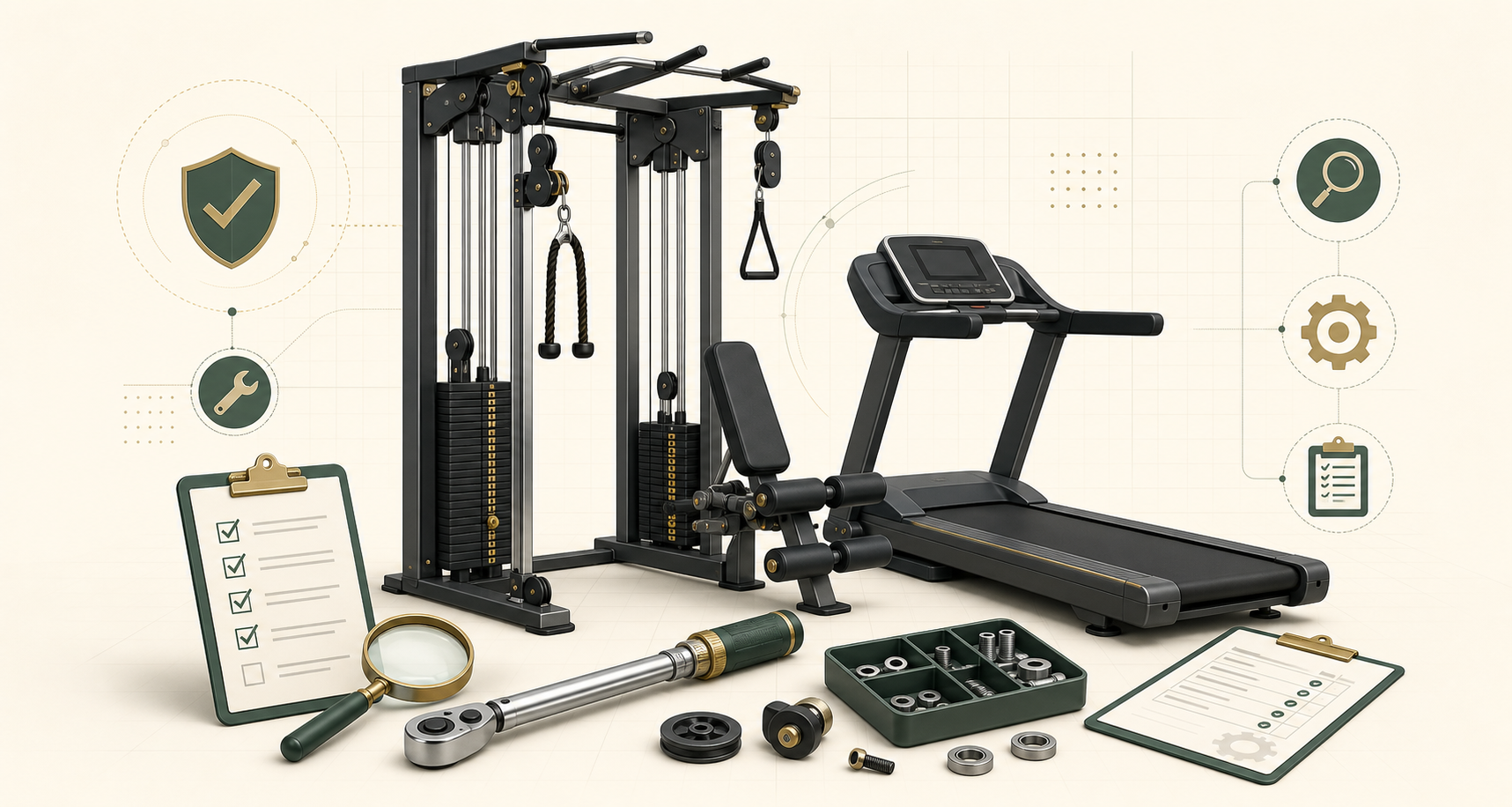
Start with risk, not a generic calendar
A calendar copied from another facility is not enough because treadmills, cable machines, benches and free-weight storage fail in different ways. Begin with the manufacturer’s instructions, actual usage, environment and the consequence of a fault, then set intervals that can be defended and revised.
The logbook should show why each task exists: preventing uncontrolled movement, spotting cable wear, confirming guards and fasteners, preserving electrical condition, or keeping access routes clear. That purpose helps staff report meaningful observations instead of simply ticking boxes.
Separate daily checks from technical maintenance
Front-line staff can record cleanliness, unusual noise, loose upholstery, damaged grips, frayed cable covering and obvious instability before opening. They should never dismantle guarded systems or improvise repairs beyond their training and the documented maintenance procedure.
Technical work belongs to a competent person with the correct tools, isolation method and service information. The record should identify who performed the work, what was inspected or replaced, and whether the machine remained unavailable pending another action.
Build one record around each asset
Give every item a durable asset ID linked to model, location, commissioning date, manuals and parts references without inventing missing specifications. A move between rooms, major repair or configuration change should remain visible in the same history rather than creating a disconnected new record.
A decision table keeps entries consistent across shifts and sites. It should distinguish observation, immediate control, responsible owner and release evidence so that a serious fault cannot disappear inside a free-text note or informal messaging thread.
| Observation | Immediate control | Release evidence |
|---|---|---|
| Cosmetic damage only | Record and monitor | Supervisor confirms no functional effect |
| Loose, unstable or abnormal movement | Remove from service | Competent inspection and functional test |
| Electrical damage or repeated trip | Isolate and prevent use | Qualified electrical assessment |
Plan parts and downtime before failure
Parts planning should follow observed wear and service criticality rather than a speculative shopping list. Record lead-time risk, compatibility evidence and storage condition for cables, belts, upholstery, fasteners and electronic modules before deciding which items justify local stock.
Downtime is easier to manage when the log also records substitute capacity and member impact. Operations teams can then schedule work outside peak periods, redirect users safely and compare whether repeated repair is still reasonable without claiming a universal replacement age.
Use clear escalation and release rules
Use simple states such as available, monitor, restricted and out of service, with authority defined for each transition. An out-of-service tag must be visible at the equipment, and the digital or paper register should prevent another shift from returning it casually.
Return to service requires evidence proportionate to the fault: visual confirmation for a minor cover replacement, functional testing after adjustment, or specialist verification after safety-critical work. The person releasing the asset should be named and the result recorded.
- Cosmetic damage only — Record and monitor — Supervisor confirms no functional effect
- Loose, unstable or abnormal movement — Remove from service — Competent inspection and functional test
- Electrical damage or repeated trip — Isolate and prevent use — Qualified electrical assessment
Boundaries, responsibilities and next step
This framework does not replace manufacturer instructions, local law, electrical rules or a competent engineering assessment. It also cannot turn an undocumented used machine into a verified asset; missing manuals, identification or repair history should be treated as procurement and risk issues.
Before requesting equipment or service support, send the asset register, photographs of the identified fault, usage context and required decision date. That evidence lets a supplier discuss compatible parts and service scope without guessing at model, condition or site responsibility.
FAQ
Should every machine have its own record?
Yes. A stable asset-level history makes location changes, repeated faults, compatible parts and return-to-service decisions traceable across staff and service visits.
Can staff choose one fixed inspection interval?
Use manufacturer guidance as the baseline, then adjust through a documented risk review that considers usage, environment, fault history and the consequence of failure.
What happens when a fault looks minor?
Record it, assess whether it affects safe function, and set an owner and review date. Cosmetic appearance alone should not determine whether equipment remains available.
Which spare parts should be kept on site?
Stock only parts with verified compatibility and a clear operational case, considering observed wear, lead time, storage needs and substitute capacity in the facility.
Does a completed repair automatically release equipment?
No. The record should include a proportionate inspection or functional test and name the person authorized to return the machine to normal service.
Sources
- Maintenance of work equipment — UK Health and Safety Executive
- Hazard Prevention and Control — US Occupational Safety and Health Administration
- F3783 Standard Guide for Inspections and Maintenance of Permanently Installed Indoor Gymnasium Equipment — ASTM International