
How to Buy Resistance Bands for a Commercial Gym
Buy resistance bands as a controlled equipment system, not as a set of colors. Define the training role for each format, request force at stated elongation points, disclose latex or other materials, inspect every handle and anchor connection, approve the storage and cleaning method, and quarantine any band with cuts, cracks, abrasion, deformation or uncertain identity. Color names alone do not create a comparable resistance schedule.
Build the band schedule from training jobs
Start with exercises and operating conditions, not a supplier bundle. Separate warm-up and mobility work, lower-body mini-loop work, assisted pull-ups, resisted sprint or strength work, handled-tube stations and coached rehabilitation use. Record who supervises each activity, how many simultaneous users the busiest session creates, the available travel length and whether a fixed anchor is involved. This prevents a large assortment from hiding gaps in the formats that members actually need.
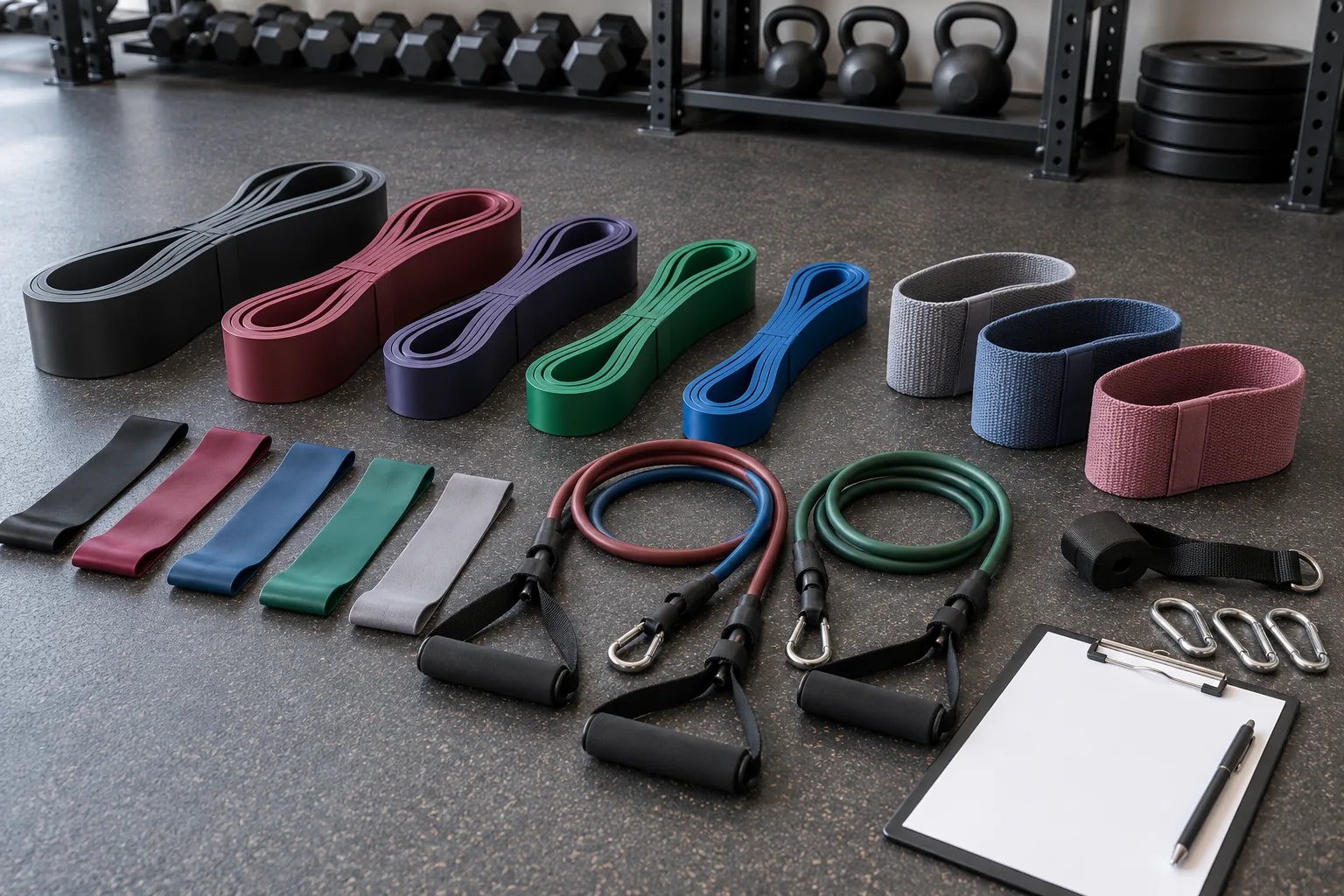
Map each job to a format and range, then set the number of active units and clean reserve units. Flat strips are easy to cut to program length, closed loops support assisted and resisted movements, mini loops suit short-range lower-body work, fabric loops change skin contact and rolling behavior, and handled tubes add end fittings that need separate inspection. Do not assume one format can substitute for another when the grip, travel or anchoring method changes.
Compare force evidence instead of color names
Ask for a force table that states the band format, nominal dimensions, test condition and force at more than one declared elongation. Elastic resistance rises as the product is stretched, so a single value without the reference length and extension point cannot define the working curve. Keep the supplier's original units alongside any conversion and require tolerances or batch acceptance rules where consistent programming matters.
Treat color as an identifier inside one approved range, not a universal standard. Two suppliers can assign the same color to different constructions or force curves, and a supplier can revise material or dimensions while retaining a familiar shade. Give every approved level a purchasing code, description and force evidence. The comparison table turns marketing labels into fields that can be checked across offers and again at receiving.
| Quote field | What to request | Why it matters |
|---|---|---|
| Format and use | Loop, strip, mini loop, textile loop or handled tube with intended training job | Prevents unsuitable substitution |
| Force evidence | Force at stated elongation points, original units and tolerance | Makes resistance levels comparable |
| Material | Elastomer, textile layers and natural-rubber-latex disclosure | Supports contact and cleaning decisions |
| Connections | Termination, webbing, stitching, clip, handle and approved anchor | Covers the complete load path |
| Control plan | Inspection, rejection, cleaning, storage, lot identity and replacement supply | Keeps the accepted system maintainable |
Specify material, construction and user contact
Request the elastomer or textile composition and a clear statement about natural rubber latex. The UK Health and Safety Executive explains that natural rubber latex contains proteins capable of causing allergic reactions; a buyer should therefore make the material visible to operators and plan a suitable non-latex option when the facility's risk assessment requires one. Do not infer allergy suitability from texture, smell or the word rubber.
Construction details change the inspection method. A solid loop needs checks for cuts, cracks, surface abrasion and permanent distortion. A layered or laminated loop adds edge separation. A textile loop adds seams, woven surfaces and any inner elastic. Tubes with handles add plugs, webbing, stitching, grommets or molded transitions. Ask the supplier to identify the points that carry load and the damage signs that require immediate removal.
Treat handles, clips and anchors as load-path components
A handled tube is a chain of components: elastic tube, termination, webbing, stitch pattern, ring or clip, handle and any ankle cuff. A CPSC recall documented tubes separating from handles, so receiving and daily checks should focus on connections rather than inspecting only the middle of the tube. Record whether a connector can rotate, abrade the elastic or be assembled incorrectly, and keep incompatible parts from being mixed between ranges.
Approve each anchor as part of the facility, not as a free accessory. TRX instructs users to ensure an anchor can withstand use and cannot cut, tear or weaken the band. A separate CPSC recall involved a door-anchor component releasing. For commercial use, identify the exact fixed anchor, rack attachment or door arrangement; confirm the supporting structure and installation with competent parties; define pull direction and clearance; and prohibit improvised edges, hinges or unknown fixtures.
Design inspection, cleaning and storage before ordering
Create a short pre-use check that staff can teach and enforce: identity readable, surface intact, no nicks or cracks, connector seated, stitching sound, handle secure and anchor approved. The manufacturer instructions in the sources call for inspection before and after use and rejection of damaged products. Provide a quarantine container and a simple log so a suspect item cannot be returned to general storage while someone waits for a purchasing decision.
Cleaning must follow the offered material and manufacturer instructions. The cited instructions use mild soap and water, thorough rinsing, air drying and storage away from direct sunlight and extreme temperatures for that specific product family. Ask every bidder to state its compatible cleaning method and prohibited chemicals. Provide smooth pegs or divided bins that avoid sharp edges, compression and tangles, and keep wet items out of closed storage until dry.
- Assign a purchasing code to every format and resistance level.
- Keep force values tied to stated elongation and original units.
- Record material and natural-rubber-latex disclosure.
- Inspect elastic, seams, terminations, clips, handles and anchors.
- Approve the installation and pull direction of every fixed anchor.
- Define cleaning, drying, storage and quarantine locations.
- Match incoming lots to the approved reference set and documents.
- Hold reserve stock under control and log every replacement.
Approve a reference set and receive the batch
Before a bulk order, approve a complete reference set rather than one attractive unit. Check dimensions, markings, grip, odors, surfaces, seams, terminations, connectors and the supplied force evidence. Run the intended exercises within the supplier's instructions, using the approved anchor and facility clearance. The trial is not a substitute for laboratory evidence; it confirms that the documented format, user handling and storage system suit the program.
At receiving, inspect selected units from every model and level under a written plan, then count and visually inspect the remaining units. Match purchase codes, material declarations, labels, instructions, connectors and storage accessories to the approved reference. Isolate lots with inconsistent dimensions, missing identity, rough edges, damaged packaging or unexplained substitutions. Photograph representative units and connection points so later replacement orders can be compared with the accepted baseline.
Write a quotation that supports safe replacement
The quotation should separate each format and resistance level, active quantity, reserve quantity, handles, cuffs, clips, anchors, storage, instructions and replacement availability. Request force evidence, material and latex disclosure, cleaning limits, inspection criteria, packing method and batch identification. If the seller offers custom colors or logos, freeze the underlying construction and resistance schedule before approving decoration so appearance does not replace technical identity.
Finish with an operating owner. Assign who checks bands, who can quarantine them, where incident and wear records are kept, and how replacement stock is released. PowerBaseFit can review a commercial accessory list together with strength stations, functional trainers, flooring and storage so the band system fits the wider room. The useful outcome is a repeatable procurement and control plan, not the greatest number of colors on a wall.
Buyer questions
Are resistance-band colors standardized between suppliers?
No universal color sequence should be assumed. Compare the supplier's format, dimensions and force at stated elongation points, then give each approved level an internal purchasing code.
Should a commercial gym buy latex-free bands?
Ask for a material and natural-rubber-latex declaration, assess the facility's users and policies, and provide a suitable alternative where the local risk assessment requires it. Do not infer composition from appearance.
Can a door anchor be used in a shared gym?
Only after the exact anchor, door, hardware, pull direction, access control and clearance are approved for the intended commercial use. An improvised door arrangement should not be treated as a verified fixed anchor.
When should a resistance band be replaced?
Remove it immediately when the manufacturer's rejection criteria are met, including visible cuts, cracks, abrasion, damaged seams, distorted connectors or uncertain condition. Use documented inspection rather than an arbitrary calendar alone.
What should a buyer approve before a bulk order?
Approve a complete reference set, force evidence, materials, labels, every connection and anchor interface, cleaning instructions, storage method, packaging and the receiving plan before authorizing the batch.
Sources
- THERABAND — Professional resistance product instructions — Performance Health / THERABAND
- TRX Commercial — Product safety for strength bands — TRX Commercial
- U.S. CPSC — Resistance tube handle-separation recall — U.S. Consumer Product Safety Commission
- U.S. CPSC — Resistance band door-anchor recall — U.S. Consumer Product Safety Commission
- UK HSE — Natural rubber latex allergy guidance — UK Health and Safety Executive