
How to Buy Training Sandbags for a Commercial Gym
Choose a commercial training sandbag from the movements, users and handling rules it must support. Separate fixed-weight bags, adjustable shells with filler inserts and handle-free strongman bags because they are not interchangeable. Specify the delivered working mass, permitted filler, insert and closure system, handle positions, intended impact limits, cleaning method, storage and rejection criteria. Approve a loaded reference unit and repeat the same weighing, grip, seam, closure and leakage checks when the order arrives.
Start with the programme, not the largest load
List the actual stations first: shoulder lunges, carries, cleans, rows, presses, bear-hug squats, ground-to-shoulder work or coached strongman lifts. Record who supervises them, how many athletes share a station and whether the bag is placed down under control or released. A bag designed for carrying is not automatically approved for repeated impact. The movement menu determines shape, grip access, working mass, floor protection and storage; it also prevents a race-preparation purchase from becoming an unsuitable general-purpose accessory.
Build a load schedule from the programme rather than copying one event. The current HYROX singles rules are useful evidence for facilities offering that specific station because they identify distinct competition loads and handling requirements. They do not prescribe the inventory for every gym. A mixed-membership facility can need lighter teaching loads, intermediate progressions and duplicate high-demand loads. State each load in kilograms, add pounds only where the local market uses them, and link every mass to a named bag configuration.
Choose the bag architecture before comparing price
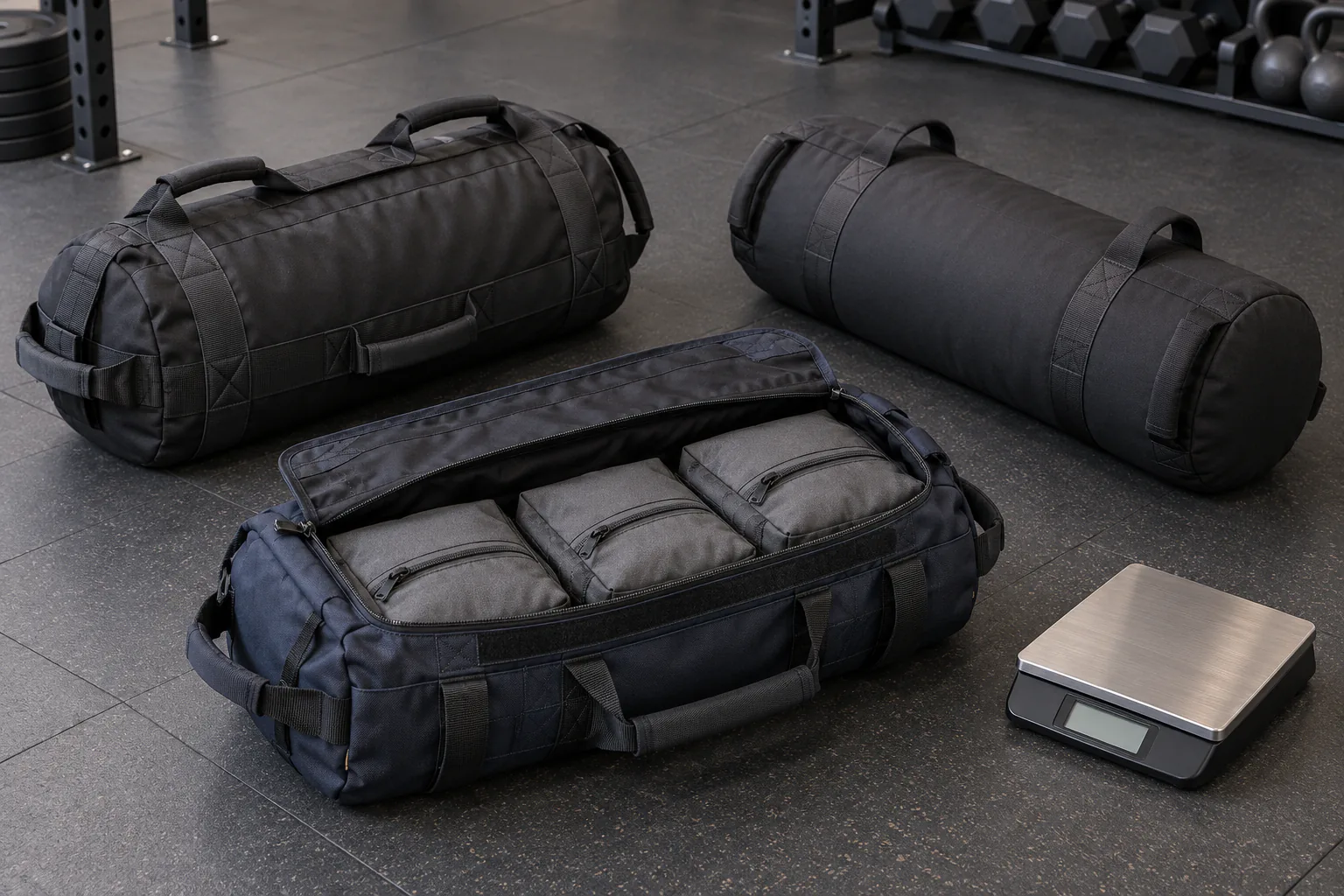
A fixed-weight power bag arrives ready for a known station and makes class setup fast. A fillable handled shell gives the buyer control over the medium and load, but adds filling, weighing, identification and leakage-control work. A strongman-style cylinder usually prioritizes bear-hug, shouldering and carrying rather than a wide handle menu. These formats create different exercises, contact points and failure modes; comparing them under one generic sandbag description hides the decision the buyer must make.
Ask whether the quoted line includes the outer shell, inner inserts, filler, weight marking and storage. Some manufacturer systems arrive with contained, prefilled modules, while others exclude the fill for transport and expect local preparation. Compare the delivered and usable system, not the shell price. Include fill material, staff time, a suitable scale, cleanup, replacement inserts and freight. A low empty-shell price can lose its advantage when a project must prepare dozens of accurately identified units before opening.
| Architecture | Best procurement use | Evidence to request |
|---|---|---|
| Fixed-weight handled bag | Fast shared-class changes and a stable load schedule | Delivered mass, handle map, construction, impact limit and replacement path |
| Fillable shell with inserts | Local load adjustment and modular replacement | Permitted medium, insert count, closure sequence, assembled tolerance and fill instructions |
| Prefilled modular system | Clean deployment where loose filling is undesirable | Module masses, containment, permitted combinations and delivered-cost scope |
| Strongman-style cylinder | Bear-hug, shouldering and controlled carries | Intended movements, surface, fill state, closure and drop boundary |
| Race-specific configuration | Practice for a named event or class standard | Current programme rule, exact load, body position and return procedure |
Turn capacity into a verified working-load schedule
Capacity is a boundary, not a promise of identical behaviour at every mass. Sand, rubber crumb, steel shot, water and proprietary inserts differ in density and movement. A shell that reaches a given mass with dense fill can become rigid, while a lower-density medium can reach the volume limit first. Follow the exact manufacturer instructions. GORUCK, for example, distinguishes recommended all-purpose sand from finer or sharp alternatives because dust, leakage, compaction and damage risk change with the medium.
Specify three separate values: the shell or insert capacity, the target assembled working mass and the permitted tolerance. Define whether the target includes the shell and all inserts. Weigh the complete unit on the same calibrated scale after filling and after the material settles, then attach a durable identity that staff can read from storage. Where the programme requires a fixed class progression, treat every load as its own controlled item rather than relying on shell color or an unverified handwritten tag.
Inspect the complete load path
Trace the load from filler to athlete. Review the inner insert seams and closure, the outer zipper or roll-and-flap system, webbing path, handle root reinforcement, main body seams and the smooth contact area. Pull each handle in the direction used by the programme. A large number of grips has value only when their positions allow the planned movements without twisting the shell, trapping the wrist or placing a seam directly against the neck or shoulder.
Request the intended-use boundary in writing. GORUCK states that one of its handled models is not built as a slam bag, while Rogue recommends a rubber or nonabrasive surface for its system. Those examples show why appearance does not prove impact permission. The order should state whether controlled floor placement, dragging, outdoor use, throws or repeated drops are permitted for the offered model. Do not extend one manufacturer's claims to a different product, and do not turn a warranty headline into a handling instruction.
Plan the live area, storage and cleaning route
Measure the complete station while the bag is in use. A lunge lane needs travel distance, turning space and a return position; cleans and shouldering need overhead and lateral clearance; group circuits need a waiting position that does not narrow an exit route. Check the actual floor and nearby edges. A soft bag can still damage a surface when dense filler concentrates at impact, and an abrasive surface can damage a shell even when the nominal weight is modest.
Choose storage from the loaded shape and retrieval method. Shelves must support the assembled mass and keep closures and handles away from sharp edges. Heavy bags should be retrieved without an uncontrolled lift from above shoulder height. Separate leaking or damaged units immediately. Obtain the offered material's cleaning and drying instructions, then provide ventilation before a damp bag returns to a closed rack. A clean exterior does not confirm that an internal filler or insert remains dry, centered and intact.
Approve one loaded reference unit
Approve a complete reference set before the volume order: one bag at every distinct architecture and at representative loads. Record shell code, unloaded mass, inserts, permitted medium, target assembled mass, dimensions after filling, handle layout, closure sequence, marking and packaging. Photograph seams, handle roots, closure layers and the final shape. Keep this record with the quotation so a change in insert count, webbing, zipper or filler cannot pass as a cosmetic production variation.
Run the intended movement menu with trained staff and controlled loads. Check access to each grip, shoulder contact, load migration, closure bulging, floor contact and the ability to return the bag to storage. After the trial, inspect for dust, grit at the closure, stretched stitching, insert movement and unreadable markings. The trial is not a universal durability test; it confirms that the exact offered configuration supports the named programme and gives the receiving team reproducible observations.
- Name the movement menu and supervision level.
- Separate fixed, fillable, modular and strongman formats.
- Record shell capacity, working mass and tolerance independently.
- Freeze the permitted filler and the party responsible for filling.
- Inspect inserts, closures, seams, webbing and every handle root.
- Confirm impact, dragging, outdoor and floor-surface limits.
- Approve a loaded reference unit with photographs and scale record.
- Repeat weight, shape, leakage and movement checks at receiving.
- Provide storage, cleaning, quarantine and replacement controls.
Write the quotation and receiving checks
The request for quotation should separate fixed and fillable models, ordered working masses, active quantity, reserve quantity, shell and insert codes, filler supply, markings, custom color or logo, packaging and spare inserts. Add permitted uses, prohibited uses, cleaning, inspection and replacement documents. For buyer-filled systems, state who supplies and installs the medium and where final weighing occurs. For prefilled systems, request the delivered mass tolerance and a method for resolving a unit that arrives outside the approved range.
At receiving, verify carton identity before opening, then count shells, inserts and accessories independently. Weigh representative complete units from every load, compare shape and dimensions with the reference, and inspect all handle roots, seams and closure layers. Exercise a risk-based selection through the approved movement sequence on the actual surface. Quarantine leakage, incorrect fill, missing inserts, inaccessible handles, distorted closures or undocumented substitutions, and resolve the finding before the equipment enters a class.
Control the bag throughout its service life
Create a pre-use check that staff can perform quickly: identity readable, weight assignment correct, shell free from cuts or abrasion, seams closed, handle roots stable, inserts contained and closure fully engaged. Define a deeper periodic review and a quarantine location. Record leakage, repairs and replacements by model and load. Do not refill, resew or substitute an insert unless the manufacturer and the facility's responsible person approve the method and the result can be reweighed and identified.
The final decision should state which architecture serves each programme, how many active and reserve units are needed, what arrives from the supplier and what the local team completes. Send that schedule with the floor plan and class capacity when requesting a factory quotation. PowerBaseFit can then review functional accessories with storage, flooring, strength equipment and project requirements without presenting an unverified shell specification as a confirmed product fact.
Buyer questions
Should a commercial gym buy filled or unfilled training sandbags?
Choose from operating capacity. Filled units reduce local preparation; unfilled systems can simplify freight and allow local adjustment, but the buyer must supply approved fill, weighing, identification, containment and labour.
Is the printed capacity the same as the working weight?
No. Capacity describes a model boundary. Filler density, headspace, insert count and shell mass affect the assembled result, so the purchase order needs a verified working mass and tolerance.
How many handles should a gym sandbag have?
There is no universal number. Map each handle position to the programmed lifts and carries, then check clearance, comfort, reinforcement and the smooth body-contact area on a loaded reference unit.
Can a training sandbag be dropped or slammed?
Only when the offered model's instructions explicitly permit that action and the surface is approved. A carrying or lunge bag must not be treated as impact equipment from appearance alone.
What should be checked when a bulk order arrives?
Count shells and inserts, verify identity, weigh representative assembled units, compare shape and dimensions, inspect closures and handle roots, check for leakage and run the approved movement sequence.
Sources
- HYROX singles rules for the sandbag-lunge station — HYROX
- Rogue training sandbag construction and filler guidance — Rogue Fitness
- GORUCK training sandbag filler and handling guidance — GORUCK
- REP fitness and strongman sandbag architecture comparison — REP Fitness
- Hyperwear prefilled modular training sandbag system — Hyperwear