
How Many Treadmills Does a Commercial Gym Need?
A commercial gym should not buy treadmills from a membership ratio alone. Calculate the base fleet from observed or forecast peak-period arrivals, the share that chooses a treadmill, average occupied minutes and the service level the operator wants to protect. Then test that count against usable floor area, electrical circuits, ventilation and maintenance capacity, and add a documented reserve only where downtime or a strict no-queue promise justifies it.
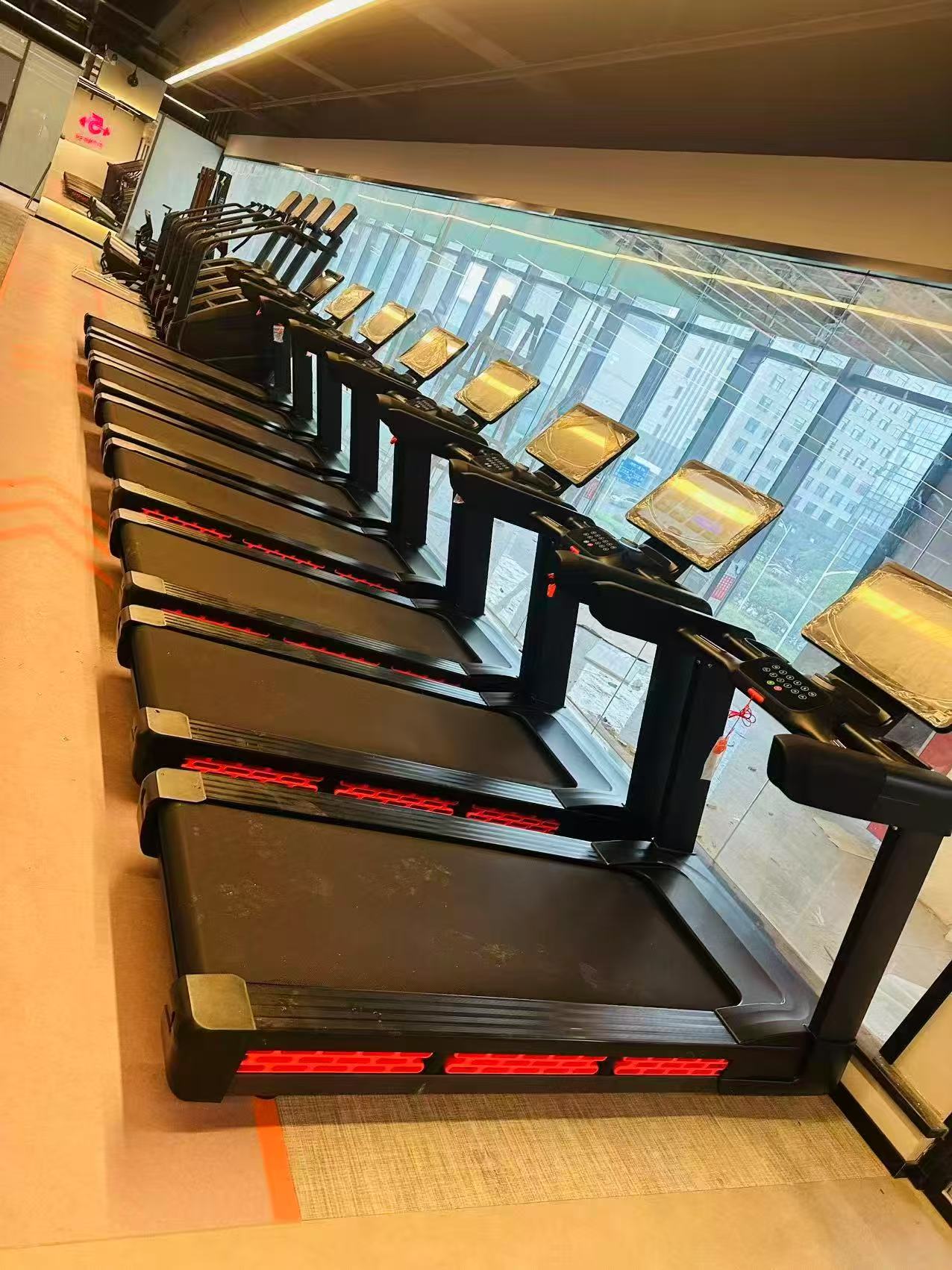
Count demand at the busiest repeatable period
Start with a four-week operating profile or, for a new site, a forecast tied to membership type, opening hours and class timetable. Record entries in fifteen-minute intervals and mark how many people begin a treadmill session. Use the busiest period that repeats, not an opening event or an isolated bad-weather evening. Separate walking, steady running, warm-up and coached treadmill use because their occupied times and willingness to switch equipment are different.
Total enrolled members remain useful for commercial forecasting, but they do not describe simultaneous load. A hotel with changing guests, a school with scheduled groups, a corporate room with lunch peaks and a 24-hour membership club all produce different demand curves. State the population, expected visits, peak arrivals, treadmill participation and confidence level as separate lines in the procurement brief so that an optimistic sales forecast cannot silently become an equipment fact.
Use a transparent capacity formula
For a chosen peak window, multiply the number of arriving users by the share expected to select a treadmill and by their average occupied minutes. Divide by the window length to obtain concurrent treadmill demand. Divide that result by the target occupied share and round up to obtain the base operating fleet. A target below full occupancy protects availability; the buyer must choose it according to the acceptable queue, service promise and budget rather than copy a universal percentage.
Run low, expected and high cases instead of presenting a single precise answer. The low case can reflect off-peak switching to bikes or outdoor running; the expected case should follow the operating plan; the high case should reflect the busiest repeatable period and longer sessions. Keep every input visible in the quotation workbook. When a supplier suggests a count, ask which input changed and why, then compare the commercial consequence rather than arguing over a ratio.
| Decision input | Evidence to collect | Effect on quantity |
|---|---|---|
| Peak arrivals | Check-in and treadmill-start counts by 15-minute interval | Sets the demand window |
| Occupied minutes | Observed session duration by use type | Converts arrivals into concurrent demand |
| Target availability | Maximum approved queue or occupied share | Creates the capacity margin |
| Downtime exposure | Service response, parts route and planned maintenance | Defines an evidence-based reserve |
| Site constraints | Scaled live area, circuits, ventilation and access | Caps the feasible installed fleet |
Adjust the count for the facility model
A general membership club often needs availability across long sessions and uneven arrivals. A hotel or apartment facility can start from guest-room occupancy, access hours and the expected share of fitness users. A school or corporate facility should model scheduled cohorts and timetable overlap. A personal-training studio may need only the treadmill functions used in coached sessions. The same floor area therefore does not justify the same fleet, and every recommendation should name the program it serves.
Treadmill time limits, reservations and signage are operating controls, not substitutes for capacity analysis. They can improve turnover when demand is brief and predictable, yet a limit that conflicts with the facility's training promise creates complaints. Model the count both with and without the proposed policy. If the purchase only works when every member obeys an aggressive limit, the operating assumption deserves explicit approval before the order is placed.
Balance treadmills with the rest of the cardio zone
Measure substitution rather than treating every cardio unit as equivalent. A member warming up may switch to a bike or elliptical, while a runner completing a programmed interval session will not. Record first choice, second choice and abandoned sessions during peak periods. This reveals whether another treadmill removes a true bottleneck or whether a broader cardio mix serves more users, access needs and training preferences within the same capital and space envelope.
For a new site, create an opening mix and reserve service connections for a later phase. Approve the second phase only after observing queue length, occupied minutes, repeat demand and equipment downtime. This staged decision protects cash and prevents a visually impressive row of underused machines. It also gives the supplier a clear option schedule, so compatible consoles, power provisions and finish choices can be priced before the expansion is authorized.
Check space, power, ventilation and access
Place the selected model's actual dimensions on the scaled plan and add the manufacturer's operating and safety clearances, especially behind the running surface. Include wheelchair and cleaning access, aisle width, emergency routes, doors, columns and sight lines. ISO 20957-6 supplies the treadmill-specific safety and test framework, but the installation still has to follow the current model documentation and local building requirements. Catalogue footprint alone is not an approved live area.
Build an electrical schedule from the exact regional configuration. Official commercial pages show that voltage and dedicated-circuit requirements are model and market specific. Confirm plug type, circuit allocation, earthing, cable route, isolators, surge protection policy and commissioning responsibility with the supplier and qualified site professional. Add the combined heat and ventilation implication to the room plan. A quantity that exceeds available circuits or cooling is not a viable fleet.
Price uptime and service reserve separately
Define the minimum number of available treadmills during the busiest period. Then model planned preventive work and a realistic service response scenario using the buyer's location, parts route and technician coverage. A reserve unit can protect the service level, but it also consumes capital, power and floor area. Compare that choice with faster spare-parts access, modular console replacement, a service agreement or a staged spare unit that is installed only when demand grows.
Request belt and deck inspection access, lubrication method, cleaning points, diagnostic logs, error-code documentation, console update process, wear-part list and technician clearances for the quoted model. Ask the supplier to identify which faults remove the whole unit and which modules can be isolated or exchanged. The fleet count should reflect maintainability evidence rather than a generic spare percentage, especially for remote sites or multi-location operators.
Turn the model into a quotation schedule
Send suppliers the facility type, country, electrical supply, usable cardio area, peak-window data, session assumptions, target availability, required console functions and expansion scenario. Request a line-by-line schedule for base units, optional reserve units, freight, installation, commissioning, training, initial wear parts and service coverage. Keep regional plugs, manuals, labels and console language in the specification so localization is verified before shipment rather than discovered during handover.
Require one layout drawing that identifies every treadmill, live area, rear clearance, outlet, circuit reference, data connection and maintenance route. The quoted bill of materials should tie each unit to a model code and console choice. This makes competing offers comparable and prevents a lower price from concealing missing electrical work, assembly, accessories or post-installation support. Record exclusions alongside inclusions and obtain written change control before production.
- Peak-period data and three demand cases
- Scaled equipment and clearance plan
- Electrical and ventilation schedule
- Base, reserve and expansion pricing
- Commissioning and utilization log template
Validate after installation and before expansion
At commissioning, verify model identity, quantity, damage condition, assembly, leveling, belt tracking, emergency stop, speed and incline operation, console functions, power connection and required clearances according to the agreed documents. Log each serial number and assign it to a floor position and circuit. Acceptance should record defects and responsibility without treating another brand's published specification as the requirement for the ordered PowerBaseFit configuration.
For the first operating months, collect fifteen-minute occupancy, queue events, session length, abandoned demand, faults and out-of-service hours by unit. Review the evidence at agreed intervals and compare it with the low, expected and high cases. Add units when repeated demand exceeds the approved service level and the building can support them; rebalance the cardio mix when members consistently substitute; improve service when downtime, not demand, creates the queue.
FAQ
Can I calculate the fleet from total membership?
Membership is one forecast input, not the final divisor. Convert it into visits during a repeatable peak window, treadmill participation and occupied minutes, then test the result against the desired availability and site constraints.
Should every cardio machine count as treadmill capacity?
Count substitution only when users accept it for the same purpose. Warm-up demand can move between equipment types; a programmed running session generally cannot. Observe first choice, second choice and abandoned use.
Is one spare treadmill always necessary?
No fixed reserve applies to every project. Define the minimum live fleet, service response, parts access and outage consequence, then price a spare unit against faster repair and phased installation.
What should I send for an accurate quotation?
Send the country, facility model, scaled room plan, electrical supply, peak demand cases, intended sessions, console needs, target availability, installation scope and expansion scenario.
Sources
- ISO 20957-1:2024 — General safety requirements — International Organization for Standardization
- ISO 20957-6:2021 — Treadmill requirements — International Organization for Standardization
- Life Fitness Integrity+ commercial treadmill — Life Fitness
- Precor TRM 791 treadmill — Precor
- Precor TRM 700 service information — Precor