Coastal Gym Equipment Maintenance Planning Solution
A credible plan for Coastal Gym Equipment Maintenance Planning Solution begins with planning materials, cleaning, inspection and spare-parts decisions for humid, salt-laden or otherwise corrosive operating conditions. It records distance and exposure to salt, ventilation, condensation, cleaning chemicals, drainage, touchpoints, fasteners, finishes, electronics, storage and observed corrosion, controls environment-appropriate material selection, protective finishes, drying, drainage, cleaning compatibility, shorter evidence-led inspections and corrosion escalation rules, and accepts the result only against baseline condition records, coating and material documentation, inspection trends, compatible repair methods and functional release after corrective work; site conditions and competent professional review remain decisive.
Define the decision behind Coastal Gym Equipment Maintenance Planning Solution
The brief should begin with planning materials, cleaning, inspection and spare-parts decisions for humid, salt-laden or otherwise corrosive operating conditions, because a product list cannot resolve an undefined operating decision. Naming users, duty, site constraints and responsible owners prevents attractive specifications from replacing the actual business requirement.
For Coastal Gym Equipment Maintenance Planning Solution, the first review must separate verified facts from assumptions. Unknown dimensions, utilities, schedules, regulations or service capability stay open in the decision log instead of being converted into confident but unsupported claims.
Record site and operating inputs
The working file should capture distance and exposure to salt, ventilation, condensation, cleaning chemicals, drainage, touchpoints, fasteners, finishes, electronics, storage and observed corrosion. Each input needs a source, owner and review date so that a layout or quotation can be revised when the building, user profile or procurement route changes.
Demand should be expressed through simultaneous users, movement needs, peak periods, delivery access and downtime tolerance. This evidence is more useful than copying quantities from another facility whose users and constraints are not verified.
Convert requirements into controls
The control strategy should address environment-appropriate material selection, protective finishes, drying, drainage, cleaning compatibility, shorter evidence-led inspections and corrosion escalation rules. Controls belong in drawings, specifications, operating procedures and the acceptance checklist, with responsibility assigned before any order is placed.
Equipment families are compared by function, adjustability, service access, documentation and compatibility with the planned environment. Brand familiarity alone is not evidence that a model fits the room or operating plan.
| Decision area | Required input or control |
|---|---|
| Inputs | distance and exposure to salt, ventilation, condensation, cleaning chemicals, drainage, touchpoints, fasteners, finishes, electronics, storage and observed corrosion |
| Controls | environment-appropriate material selection, protective finishes, drying, drainage, cleaning compatibility, shorter evidence-led inspections and corrosion escalation rules |
| Acceptance evidence | baseline condition records, coating and material documentation, inspection trends, compatible repair methods and functional release after corrective work |
Test risks before ordering
Risk review asks what happens if an assumption is wrong: blocked circulation, structure or noise conflict, inaccessible equipment, delayed parts, unsafe commissioning or unplanned downtime. High-consequence unknowns are escalated before price comparison.
Controls must be proportionate and testable. A concept image, catalogue statement or generic warranty can explain intent, but none proves local compliance, structural capacity, acoustic performance or completed installation quality.
Specify acceptance evidence
Acceptance should be based on baseline condition records, coating and material documentation, inspection trends, compatible repair methods and functional release after corrective work. The responsible reviewer records deviations, corrective actions and the authority to release equipment, so delivery is not treated as automatic completion.
Handover should connect asset identity, manuals, approved configuration, inspection results, staff information, spare-parts references and maintenance ownership. Open actions remain visible until evidence closes them.
- distance and exposure to salt, ventilation, condensation, cleaning chemicals, drainage, touchpoints, fasteners, finishes, electronics, storage and observed corrosion
- environment-appropriate material selection, protective finishes, drying, drainage, cleaning compatibility, shorter evidence-led inspections and corrosion escalation rules
- baseline condition records, coating and material documentation, inspection trends, compatible repair methods and functional release after corrective work
State boundaries and next step
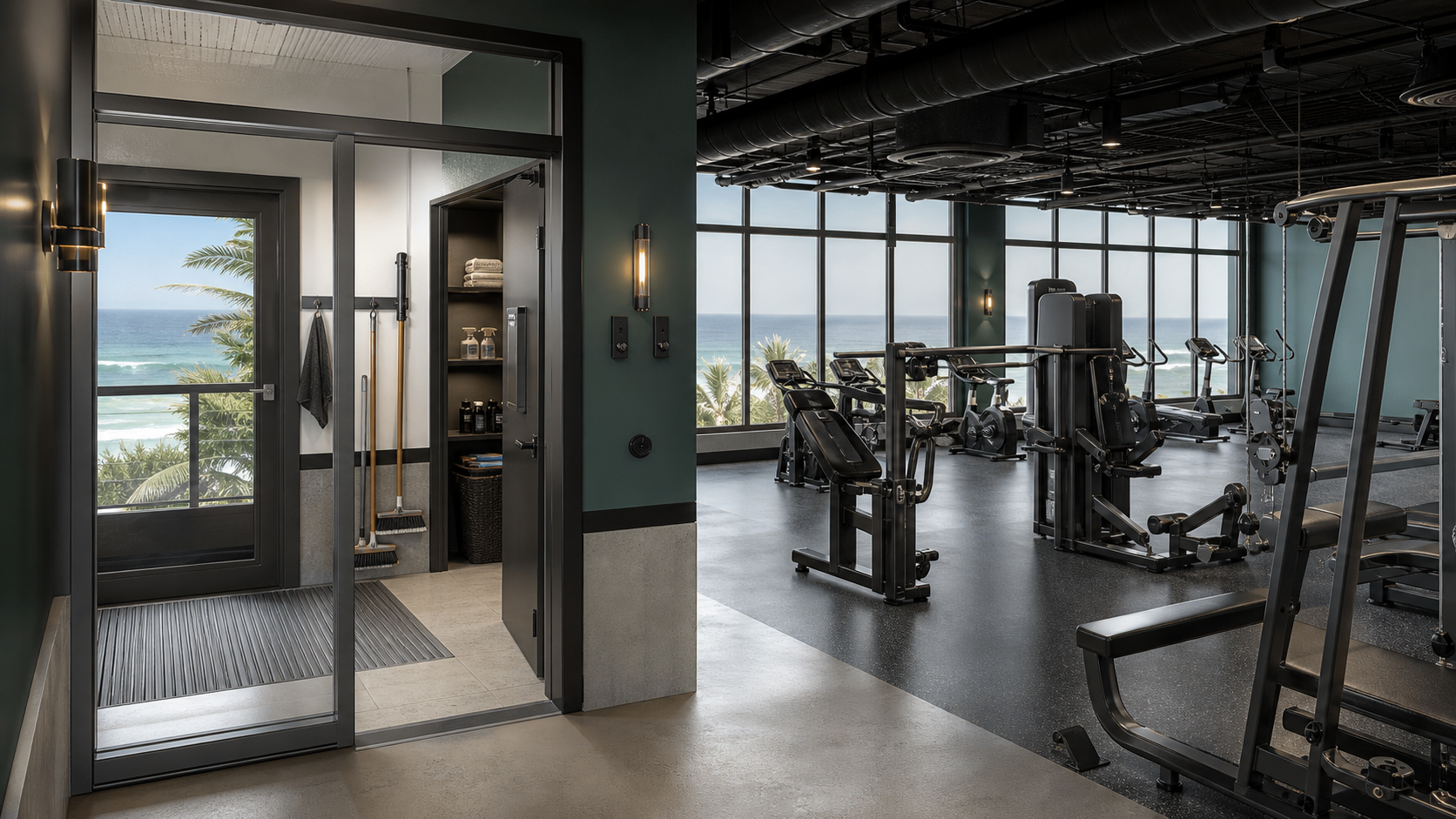
This page is a planning solution, not a report of a PowerBaseFit customer project. It states no client, address, floor area, equipment quantity, measured result or regulatory approval, and the illustration is explicitly conceptual.
The next useful step is to provide a measured plan, delivery route, user profile, operating schedule, utility information and purchasing rules. PowerBaseFit can then discuss suitable equipment and documentation without guessing at site facts.
Frequently asked questions
Is Coastal Gym Equipment Maintenance Planning Solution a real customer case?
No. It is an evidence-led planning guide and does not claim a named client, completed installation, equipment quantity, approval or measured result.
What information is needed first?
Start with distance and exposure to salt, ventilation, condensation, cleaning chemicals, drainage, touchpoints, fasteners, finishes, electronics, storage and observed corrosion, plus a measured plan, user profile, operating schedule, delivery route and the person responsible for decisions.
How should suppliers be compared?
Compare documented function, dimensions, adjustability, service access, manuals, compatible parts, warranty boundaries and acceptance evidence against the same requirement.
What must be checked on site?
Local professionals should validate building, accessibility, electrical, fire, acoustic and other applicable requirements; a supplier page cannot certify those conditions.
When is the plan ready to order?
It is ready only when material assumptions are resolved, responsibilities are assigned, environment-appropriate material selection, protective finishes, drying, drainage, cleaning compatibility, shorter evidence-led inspections and corrosion escalation rules are documented and baseline condition records, coating and material documentation, inspection trends, compatible repair methods and functional release after corrective work can be verified at handover.
Evidence sources
Evidence note: A practical decision guide for Coastal Gym Equipment Maintenance Planning Solution, covering evidence, layout, acceptance, maintenance and accountable next steps.
- Equipment Condition and Corrosion — US Occupational Safety and Health Administration
- Corrosion Control — NASA Kennedy Space Center
- Coatings Data — NASA Kennedy Space Center