
Introduction
Chain-drive forearm machines usually deliver a direct mechanical connection and clearly transmitted movement, while cable-drive machines can offer flexible routing and a smoother-feeling resistance path. Neither system is automatically superior. Commercial buyers should compare movement purpose, load transfer, adjustability, inspection access, replacement parts and the users the machine must serve.
Key takeaways
- Define the movement: Specify wrist, forearm or grip action and the intended user position.
- Inspect the force path: Trace how the grip transfers resistance through chain, cable, pulleys, sprockets and bearings.
- Review user geometry: Check grip diameter, pad position, wrist alignment, starting range and adjustments.
Planning context
A forearm training machine can look simple from the outside: a grip, a rotating drum or lever, a support pad and a resistance source. The buying decision becomes more technical when the machine uses a chain or cable to transfer resistance. That transmission affects how the mechanism is packaged, how resistance reaches the user's hands, what staff must inspect and how easily the product can be serviced in a busy strength club or combat-sports facility.
The correct comparison is not a contest between two materials. It is a review of the entire system. Chain pitch, sprocket alignment, cable construction, pulley diameter, termination points, guarding, bearing support, adjustment geometry and resistance source work together. A weakly designed chain system can be noisy or awkward, while a poorly routed cable system can create friction and wear. A well-designed version of either can support useful commercial forearm training when it matches the application.
How Chain and Cable Drive Systems Transfer Resistance
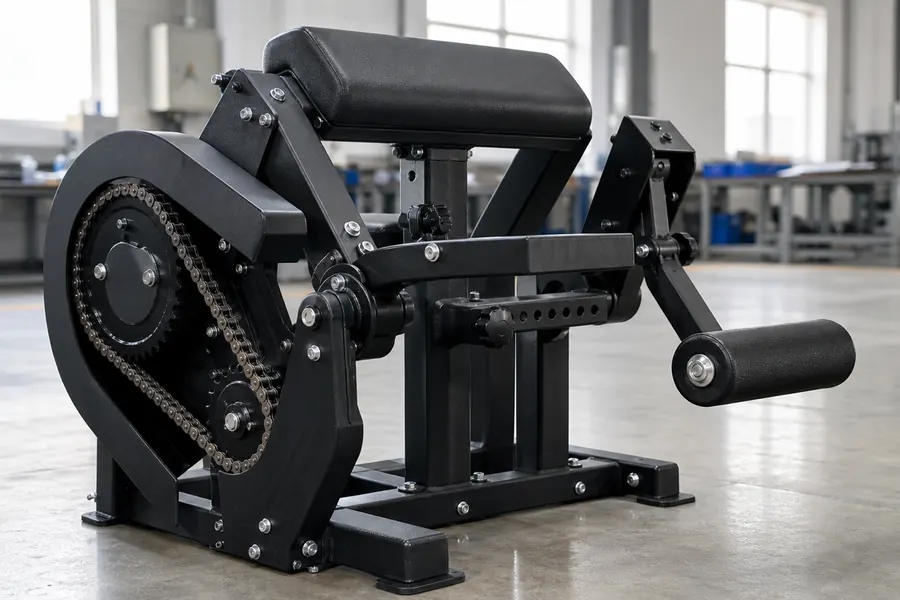
A chain-drive system transfers force through linked metal segments engaging one or more sprockets. On a forearm trainer, rotation at the grip drum or movement arm turns a sprocket, and the chain carries that motion to a loading lever, plate horn or another resistance element. The positive engagement between chain and sprocket means the drive path is mechanically defined. Buyers should inspect alignment, chain tension, guard coverage and the way the chain enters and leaves each sprocket.
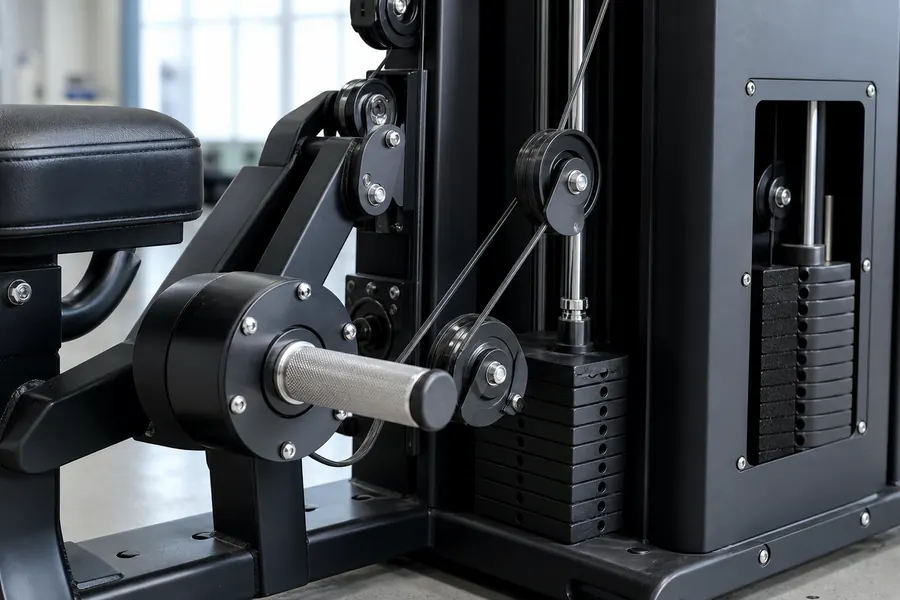
A cable-drive system transfers force through a flexible cable running over pulleys or around a drum. The cable may connect the grip mechanism to a weight stack, plate-loaded lever or cam. Routing can change direction without requiring a sprocket at every turn, which gives designers more freedom to place the resistance source and user position. That freedom also creates more routing decisions. Pulley alignment, bend radius, cable termination, contact surfaces and access for replacement all matter.
Resistance Feel Comes from the Complete Geometry
Buyers often describe chain systems as direct and cable systems as smooth, but those descriptions are not guarantees. Perceived resistance is influenced by drum diameter, lever length, cam profile, bearing friction, load position and the change in mechanical advantage through the movement. A chain can feel controlled when tension and alignment are correct. A cable can feel inconsistent if it rubs, crosses a pulley incorrectly or uses a route that changes leverage unexpectedly.
For forearm work, the starting position and rotational range deserve special attention. Users need a grip that lets the wrist begin without excessive flexion or extension, and the support pad should keep the forearm stable without forcing the shoulder forward. Test the movement in both directions if the product is intended for wrist flexion and extension. Evaluate low and moderate resistance settings rather than judging the mechanism only under a heavy demonstration load.
Commercial Maintenance Is an Inspection System, Not a Material Assumption
A chain is not maintenance-free because it is metal, and a cable is not automatically easy to replace because it is flexible. Facility staff need a defined inspection path. For chain systems, that may include checking tension, lateral alignment, link condition, sprocket teeth, fasteners and the guard. Any lubrication practice should follow the manufacturer's instructions because excess lubricant can attract debris or reach contact surfaces where it does not belong.
Cable inspection should cover the full visible run, especially near terminations, pulleys and points where the cable changes direction. Staff should look for coating damage, deformation, broken strands, movement outside the pulley groove or contact with frame edges. The machine should be removed from use when a safety-related defect is found. A commercial buyer should ask how the transmission is accessed, how replacement parts are identified and whether ordinary service requires unusual disassembly.
Quality Inspection Points for Chain-Drive Forearm Machines
From a manufacturing perspective, chain alignment begins with the relationship between shafts, bearings, sprockets and welded mounting points. A sprocket can be well made yet run poorly if the supporting structure places the shafts out of plane. Inspection should confirm that the chain tracks consistently, tension adjustment has usable travel, rotating parts do not contact the guard and the mechanism returns or settles without binding.
Guarding should prevent unintended contact while still allowing authorized inspection and service. Fastener access matters because an attractive cover that blocks adjustment can increase service time. Buyers should also review the grip drum, axle support and forearm pad. The drive may be the focus of the comparison, but the user experiences the handle diameter, texture, wrist position and pad geometry on every repetition.
Quality Inspection Points for Cable-Drive Forearm Machines
Cable performance depends on a controlled route. Pulleys should align with the incoming and outgoing cable path, rotate freely and retain the cable in the groove during the full movement. The route should avoid sharp bends and uncontrolled rubbing. Terminations must be appropriate for the cable design and positioned so inspectors can see the critical connection without removing unrelated assemblies.
Where a weight stack is used, guide-rod alignment, selector-pin engagement and stack travel become part of the forearm machine review. The rotating grip mechanism should not introduce slack that allows the cable to jump or settle unpredictably. Ask how cable length is specified for replacement and whether the supplier provides a part drawing or identification method. A generic cable of similar appearance may not reproduce the original length, termination or construction.
Match the Drive System to the Commercial Application
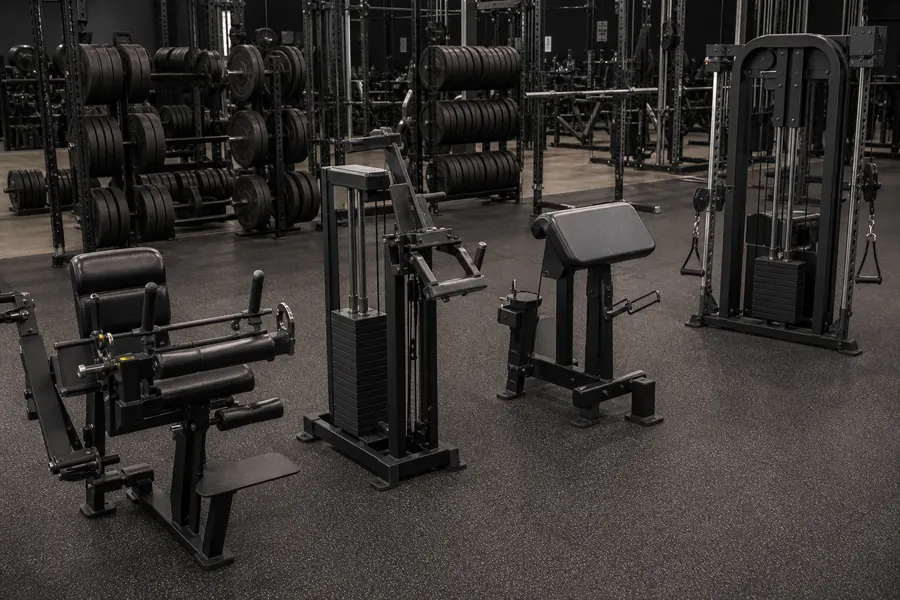
A strength club may prefer a compact plate-loaded forearm or gripper station near preacher curls, arm machines and plate storage. In that environment, a visible chain mechanism can fit the training character, provided it is guarded and accessible. Coaches can teach the movement as a dedicated accessory station, and the operator can keep related plate-loaded equipment in one service and loading zone.
A general commercial gym or performance center may prefer a selectorized cable-driven station because resistance changes are fast and the mechanism can be enclosed. Combat-sports gyms may value either format depending on coaching style, available floor area and the need to serve athletes with different training histories. The important question is whether the machine adds a repeatable forearm or grip function that existing cables, dumbbells and free weights do not already provide efficiently.
How Buyers Should Choose Between Chain and Cable Systems
Start with the training purpose. Define whether the machine trains wrist flexion and extension, crush-style gripping, rotational control or a broader arm movement. Then review the user position, adjustment range and resistance source. Only after the function is clear should the buyer compare transmission formats. This prevents a mechanically interesting design from winning even though it does not solve the facility's training need.
Request mechanism photos or drawings that show the drive path, guarding and inspection access. Ask which parts are considered wear items, how they are identified and what routine checks are recommended. Compare the complete installed footprint, including plate loading or stack access. If possible, have users with different forearm lengths and hand sizes evaluate the starting position at several resistance levels. Record observations about setup, not unsupported claims about which system feels better.
Compare Total Ownership and Distributor Support
Importers and distributors should evaluate whether the mechanism can be explained, demonstrated and supported after sale. A chain system may require clear guidance on tension and sprocket inspection. A cable system may require replacement cables with exact routing and terminations. The supplier should be able to provide parts identification, maintenance information and packing protection for exposed handles, pulleys or guards.
Consider product-line consistency. If most of a distributor's commercial range uses cables and weight stacks, a cable-driven forearm unit may fit existing parts and service conversations. If the range is strength-focused and plate-loaded, a chain-driven specialist machine may create a coherent extension. Consistency should not override function, but it can reduce training and inventory complexity when two products otherwise meet the same need.
Buyer decision framework
- Define the movement: Specify wrist, forearm or grip action and the intended user position.
- Inspect the force path: Trace how the grip transfers resistance through chain, cable, pulleys, sprockets and bearings.
- Review user geometry: Check grip diameter, pad position, wrist alignment, starting range and adjustments.
- Map service access: Identify wear points, guards, adjustment points and the replacement procedure.
- Match the facility: Choose the system that fits training purpose, floor plan, staff capability and product-line logic.
Buyer checklist
- Training purpose and movement direction are clearly defined.
- Drive path is visible in a drawing, video or physical inspection.
- Chain tension or cable routing can be inspected safely.
- Grip diameter, texture and wrist position suit the intended users.
- Forearm pad and seat or standing position are adjustable where needed.
- Guards protect users without blocking authorized service.
- Wear parts and replacement part numbers can be identified.
- Routine inspection instructions are available before purchase.
- Installed working space includes loading and service clearance.
Common buying mistakes
- Choosing by material alone: Chain or cable quality cannot compensate for poor alignment, geometry, guarding or user setup.
- Testing only at high resistance: Low and moderate settings often reveal slack, friction and starting-position problems more clearly.
- Ignoring grip and pad geometry: The transmission can work correctly while the user's wrist and forearm position remain uncomfortable.
- Treating covers as proof of safety: Guarding must protect contact points while allowing inspection and authorized maintenance.
- Ordering without parts planning: A specialized machine becomes difficult to support when chains, sprockets, cables or terminations cannot be identified.
Manufacturer perspective
From a commercial equipment manufacturer's perspective, the drive system must be reviewed as part of the frame and user geometry. Shaft alignment, pulley or sprocket mounting, bearing support, welding location, guard clearances and the resistance source are connected design decisions.
For production and quality inspection, the useful standard is repeatability: the drive should track in the intended path, the adjustment should remain accessible, the handle should rotate without unintended contact and the completed unit should match the approved configuration. Buyers should request evidence about these checkpoints instead of accepting a general claim that one transmission type is always more durable.
Chain Drive vs Cable Drive Comparison
| Factor | Chain Drive | Cable Drive |
|---|---|---|
| Resistance Feel | Often feels mechanically direct; final feel depends on sprockets, bearings and leverage. | Can feel progressive and smooth; final feel depends on routing, pulleys, cable and cam geometry. |
| Movement Characteristics | Positive engagement follows a defined sprocket path and suits compact rotational mechanisms. | Flexible routing can redirect force and connect the user mechanism to a remote stack or lever. |
| Maintenance Considerations | Inspect tension, alignment, lubrication guidance, link condition, sprockets and guards. | Inspect coating, strands, terminations, pulley alignment, grooves and contact points. |
| Commercial Application | Useful where a robust, visible mechanical drive and direct rotational action fit the product concept. | Useful where flexible routing, stack integration or enclosed resistance packaging is preferred. |
| Suitable Users | Strength-focused members and coached users who value a clear mechanical movement. | Mixed users when adjustment, controlled travel and familiar selectorized operation are priorities. |
| Buying Considerations | Guarding, tension access, chain specification, sprocket support and replacement compatibility. | Cable specification, bend radius, pulley size, termination design and replacement procedure. |
Useful next pages
Buyer FAQ
What is the difference between chain drive and cable drive in a forearm machine?
A chain engages sprockets to transfer movement, while a cable travels over pulleys or around a drum. Chain systems provide positive mechanical engagement; cable systems allow more flexible routing. Final performance depends on the complete design.
Is chain drive better for heavy commercial use?
Not automatically. Commercial suitability depends on chain specification, alignment, bearings, guarding, frame support, inspection access and the actual usage pattern. A well-designed cable system can also support commercial use.
Do cable-drive forearm machines feel smoother?
They can, but perceived smoothness also depends on pulley alignment, cable routing, cam or drum geometry, bearings and resistance source. Buyers should test the full movement at several settings.
What maintenance does a chain-drive machine need?
Inspect chain condition, tension, sprocket alignment, fasteners, bearings and guards. Follow the supplied guidance for cleaning or lubrication and stop use when a safety-related defect is found.
What should buyers inspect on a cable-drive machine?
Inspect the cable coating and strands, terminations, pulley grooves, alignment, retention, frame contact points and the connection to the resistance source.
Which system is easier for distributors to support?
The easier system is the one supported by clear parts identification, service instructions and accessible wear components. Existing technician experience and parts inventory also influence the answer.
Can a forearm machine train both wrist flexion and extension?
Some designs support both directions through grip position or mechanism configuration. Buyers should confirm the intended movement, starting range and instructions for the exact model.
What information should I request before ordering?
Request mechanism images or drawings, movement description, adjustment range, drive specification, guarding details, maintenance instructions, wear-parts list, packing method and installation requirements.
Conclusion
Chain and cable drives are two engineering routes to the same commercial goal: transferring resistance to a controlled forearm or grip movement. The better choice is the system whose geometry, inspection access, parts support and user setup fit the facility. Buyers should compare complete machines rather than isolated transmission labels. A clear supplier discussion should connect the drive path to the intended users, floor position, maintenance plan and long-term support requirements.
Need this topic turned into a real equipment plan?
Send your market, gym size, product categories or OEM needs. Kloe can help clarify the next step.