
Self-Powered Curved vs Motorized Treadmills for Commercial Gyms
Choose a self-powered curved treadmill when the facility has a defined need for self-paced acceleration, sprint intervals or resisted conditioning and can teach users how to control the belt. Choose a motorized treadmill when walking, steady prescribed pace, powered incline and broad unsupervised familiarity are central. Many commercial gyms need both. Compare the exact offered models for running surface, step-up, stop behaviour, resistance or incline range, electrical configuration, console, service parts, complete live area, delivery and acceptance evidence before fixing quantities.
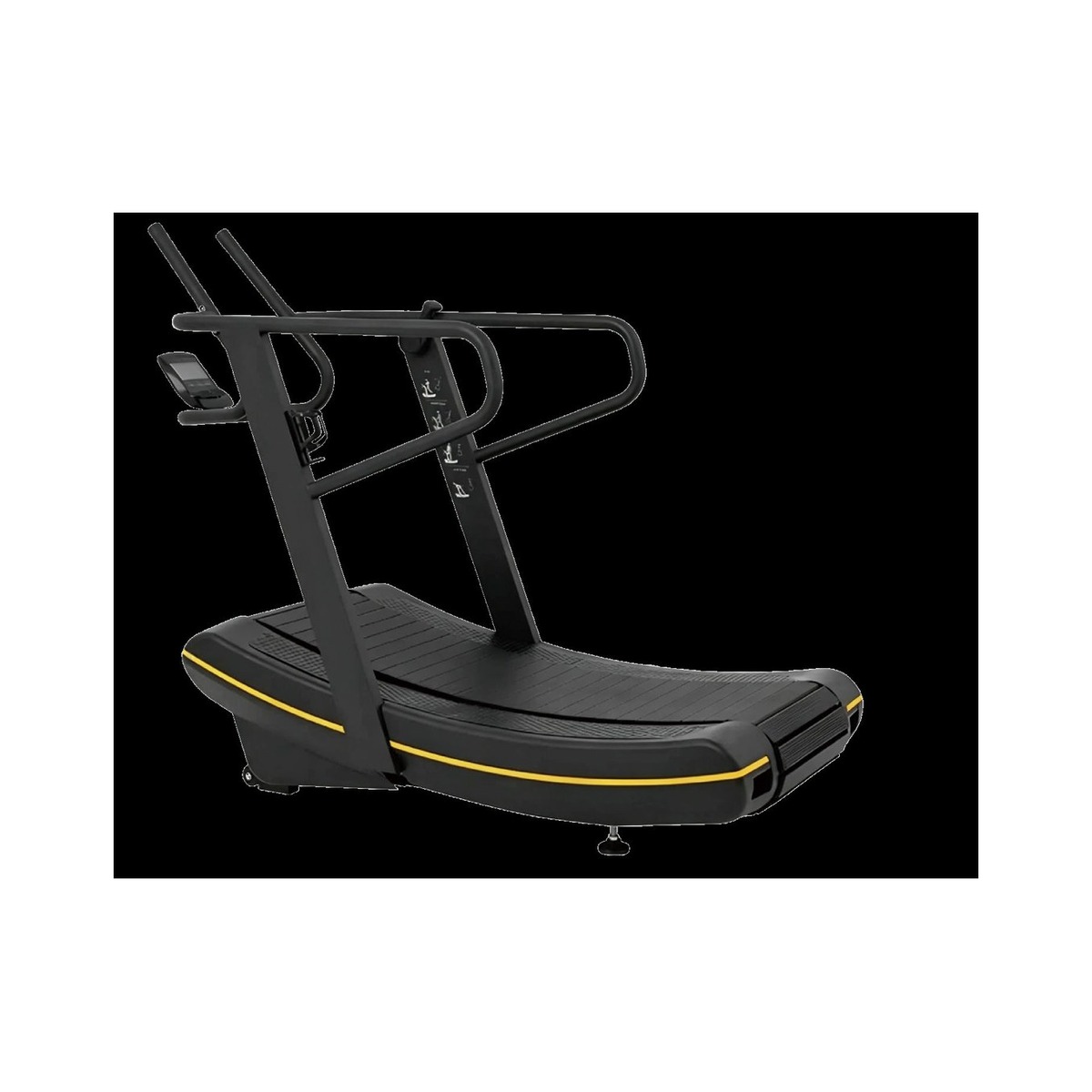
Start with the training job, not the curved deck
A curved belt is a control system, not a decorative variation. The runner changes speed by producing force and changing position on the curve, so acceleration, deceleration and rhythm depend on interaction with the machine. That behaviour can suit coached performance sessions, intervals and short work-to-rest rotations. It does not automatically suit every member who expects a start button and a fixed walking speed.
A motorized treadmill commands belt speed and often adds powered elevation, programmed workouts and a larger console choice. That supports repeatable walking, steady running and prescribed sessions across a broad membership. Write the required tasks first: walking minutes, endurance pace, sprint duration, resisted pushes, class turnover, supervision level and accessibility needs. A purchase decision should cover those tasks rather than declare one drive type universally superior.
Map users, supervision and peak-period behaviour
Record who will use each station and under what supervision. A performance centre with coaches can introduce belt position, safe mounting and rapid changeovers. A hotel or open-access club receives first-time users, older adults and guests who expect familiar controls. Representative trials should include the intended user range instead of one experienced runner, because confidence, step-up, hand position and the ability to stop smoothly affect real adoption.
Capacity also differs from simple machine count. A curved unit used for 20-second efforts in a coached circuit can serve several athletes in sequence, while one endurance runner can occupy a motorized unit for a long session. Observe or forecast arrivals, session length and queue tolerance for each task. Then assign quantities to walking, steady running and conditioning demand separately before combining them into a cardio schedule.
Normalize the two systems before comparing quotations
Supplier descriptions use different labels for manual, non-motorized, self-powered, curved, resistance and hybrid formats. Ask each bidder to state how the belt moves, how the user changes pace, whether resistance is adjustable, how the display is powered and which functions depend on a wall connection. For motorized units, record commanded speed, elevation, stop systems and the destination-specific electrical requirement for the exact configuration.
Use the same decision rows for every offer. Do not transfer a feature from one reference model to another or assume that every curved machine has no powered component. The comparison should also name excluded functions. A model without powered incline, fixed-pace control or a full entertainment console can still be the correct performance tool when those omissions are explicit and match the programme.
| Decision row | Self-powered curved treadmill | Motorized treadmill | Evidence to request |
|---|---|---|---|
| Primary task | Self-paced acceleration, intervals or resisted conditioning where equipped | Walking, steady running, prescribed speed and powered elevation where equipped | Programme schedule and representative-user trial |
| Pace control | Runner changes belt speed through effort and position | Drive system maintains the selected belt speed | Current operating instructions and stop demonstration |
| Resistance and elevation | Curve geometry; some models add a resistance mechanism | Model-specific speed and elevation ranges | Offered configuration sheet, not a family brochure |
| Utilities and console | Drive can be manual while display or brake has its own supply | Destination voltage, plug, circuit, console and network need confirmation | Nameplate, electrical schedule and console option |
| Service system | Inspect slats or belt, bearings, guides, resistance and display components | Inspect belt, deck, rollers, drive, elevation, controller and console | Maintenance tasks, wear-part list and service access |
| Site planning | Measure step-up, full frame, moving user, rear clearance and handling route | Measure the same items plus cable routing and electrical isolation | Scaled plan, packaged data and installation instructions |
Measure the complete operating and delivery envelope
Catalogue footprint is only the stationary frame. Plot the runner, entry and exit, rear safety zone, side access, service opening, adjacent circulation and the reach of doors or glazing. Add the deck height to the tallest intended user and the site’s required overhead allowance. A curved machine can be heavy even without a drive motor, so a project still needs verified floor loading, level support and a route that protects lifts, thresholds and finishes.
Request packaged dimensions, package mass, split points, lifting guidance and final-location assembly instructions before dispatch. Check every doorway, turn, lift car, stair landing and loading-bay restriction against the largest handled component, not only the assembled width. Define who unloads, moves, assembles, anchors when instructed, levels and removes packaging. A curbside freight line is not an installed commercial handover.
Build utilities and data around the offered configuration
For a motorized fleet, the local electrical designer needs model-specific voltage, frequency, current, plug, grounding, isolation and circuit information. Console choice can also add network, television or account requirements. Place outlets and data points where cords stay protected and service personnel can isolate the unit. Do not size a whole row from one generic power figure or from a different country’s product page.
For a curved unit, separate mechanical drive from electronics. A standard display can be battery-powered or self-powered, while another console or adjustable resistance system can use a wall connection or adapter. Ask what stops functioning when external power is absent and what batteries or chargers enter routine service. Record those answers in the equipment and building schedules so a late console selection does not invalidate the room plan.
Price maintenance, parts and downtime by system
Removing a drive motor does not remove inspection. Curved machines still contain a running surface, bearings or rollers, guides, fasteners, frame contact points and display components; resistance-equipped versions add another service path. Motorized treadmills add drive, belt and deck interaction, elevation parts, controllers and electrical diagnosis. Use the current instructions for each offered model to list cleaning, inspection, adjustment and competent service tasks.
Ask for part identity, expected replacement triggers, local stock route, technician capability, diagnostic access and the boundary between buyer maintenance and authorized work. Compare warranty scope by component and duty, but build the operating plan around documented wear and response responsibility rather than the longest headline term. A lower energy line does not prove lower lifecycle cost if parts, freight or service access remain undefined.
Send one evidence-led request for quotation
Give bidders the same programme, user, site and service brief. Require a line for every included console, resistance feature, accessory, delivery task, installation task, electrical item, document, spare and acceptance test. If two formats will share the floor, state the planned quantity of each and the operational reason. That prevents a low total from hiding an incomplete console, curbside-only delivery or a residential-use configuration.
Approve a production-representative unit or documented configuration before a larger order. Trial mounting, walking, steady running, acceleration, deceleration, emergency or normal stop, resisted mode where fitted, console readability, cleaning reach and routine service access. Record the settings and evidence used so receiving teams can compare delivered units with the accepted configuration instead of relying on memory.
- Facility country, destination voltage and installation address
- Operating model, opening hours and supervision level
- Expected walking, steady-running, sprint and resisted-training demand
- Representative user range and accessibility considerations
- Required quantity by treadmill format and busiest-hour schedule
- Running surface, step-up, control, stop and console evidence
- Complete dimensions, clearances, package data and delivery route
- Electrical, battery, charger, network and data responsibilities
- Maintenance tasks, wear parts, service tools and response ownership
- Reference-unit approval, installation records and site acceptance tests
Receive the fleet as a controlled system
At arrival, match model and console identity to the approved schedule, inspect packaging and finish, count loose parts, and preserve damage evidence before assembly. After installation, verify stability, level, running-surface movement, controls, stop functions, resistance or elevation, console data, power arrangement and abnormal sound under the documented test. Keep a unit unavailable when a safety or functional result is unresolved.
The final decision is not curved against motorized in isolation. It is a documented fleet that covers the facility’s walking, running and conditioning work with usable controls, supported utilities and serviceable parts. Send PowerBaseFit the country, floor plan, user profile, task mix, proposed quantities and purchase timing to prepare a configuration discussion and model-specific evidence request.
Buyer questions
Can a curved treadmill replace every motorized treadmill in a commercial gym?
No. A curved unit can be valuable for self-paced acceleration and conditioning, while a motorized unit supplies commanded pace, familiar walking and powered elevation where specified. Replace a motorized station only when the intended users and programme no longer require those functions.
Does self-powered always mean that no electricity is needed?
No. The belt drive can be manual while the selected display, charger, connectivity or resistance brake uses batteries, generated power, an adapter or a wall supply. Confirm the exact console and resistance configuration in the destination electrical schedule.
Which format fits an unsupervised hotel or apartment fitness room?
Start with user familiarity, walking demand, operating hours and local risk controls. A motorized treadmill often supports familiar steady use, while a curved unit requires clear onboarding and a defined training role. Trial representative users and review the exact instructions before deciding.
How many curved treadmills should a gym buy?
Calculate from peak conditioning arrivals, work interval, recovery interval, group size and acceptable queue rather than total membership. Keep walking and steady-running demand in a separate capacity model, then test whether a mixed fleet covers both schedules.
What should buyers compare beyond motor horsepower or a no-motor label?
Compare user task, pace control, running surface, step-up, stop behaviour, resistance or elevation, console, complete live area, delivery package, electrical details, wear parts, service responsibility, warranty scope and the evidence required for acceptance.
What information should accompany a factory quote request?
Send the destination country, facility type, floor plan, delivery route, user profile, operating hours, supervision, target sessions, quantities by format, console needs, utility conditions, service expectations and procurement timing. Ask for model-specific documents for every offered configuration.
Sources
- ISO stationary training equipment catalogue — International Organization for Standardization
- ASTM F2115 treadmill specification — ASTM International
- WOODWAY Curve official product information — WOODWAY
- Life Fitness Integrity commercial treadmill — Life Fitness
- REP Strive curved treadmill — REP Fitness