
How to Choose an Assisted Pull-Up and Dip Machine for a Commercial Gym
Choose an assisted pull-up and dip machine when the facility needs one coached progression from substantial counterweight support to unassisted bodyweight work. Do not select it by stack mass alone. Confirm the lightest and greatest usable assistance, increment size, platform travel, entry steps, grip positions, overhead clearance and the ability to fold or park the support for unassisted work. Trial short, tall, light and heavy representative users on the exact unit. Then record the approved assistance behaviour, complete live area, service access, documentation and receiving tests in the purchase order.
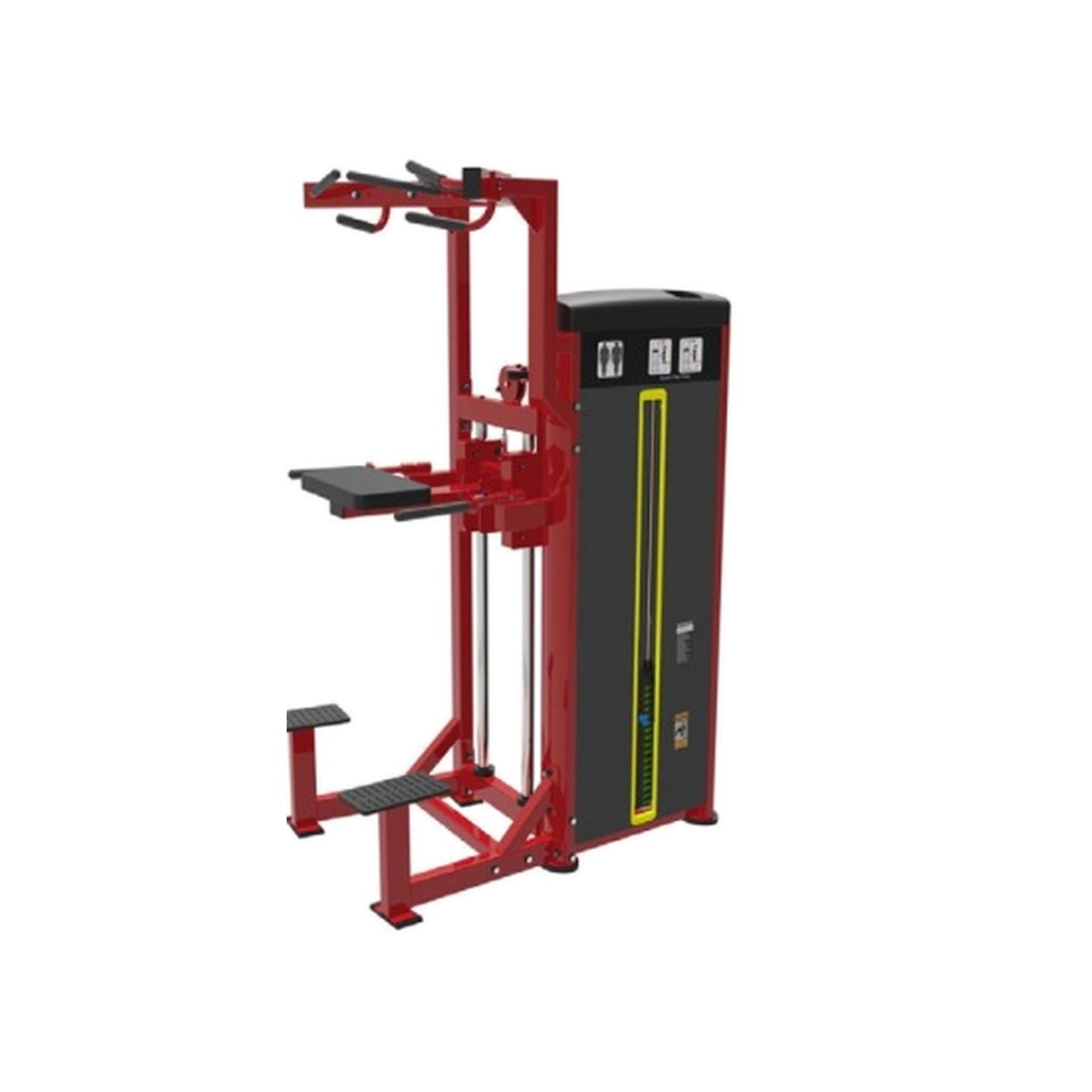
Start with the users and the progression the floor must support
Map the members who cannot yet perform repeatable pull-ups or parallel-bar dips, the coaching programmes that teach those movements, and the advanced users who need controlled assistance for volume or return-to-training work. Observe busy periods, occupied minutes, alternative stations and staff interventions. A dedicated machine earns its space when it closes a documented progression gap instead of duplicating an underused pull-up bar.
Define the operating context. A general membership club can value simple selection and broad user access; a school, hotel or corporate room can value clear instructions and a controlled setup; a performance facility can need easy transition to unassisted repetitions. Importers and distributors must also consider how the station fits a selectorized line, which wear parts must be stocked and how buyers will compare it with a rack, dip stand or connected multi-station.
Choose the station format before comparing catalogues
A standalone selectorized station reserves its assistance mechanism for one user and is easy to place in a conventional strength circuit. A connected jungle or modular station can share towers and reduce duplicated structure, but its queues and service shutdowns affect several exercises. A fixed pull-up and dip station uses less mechanism and suits users who already control bodyweight. Bands on a rack cost less, yet setup, band condition and assistance change through the movement require tighter coaching.
Compare the complete operating system rather than the product name. Include access steps, moving platform, unassisted mode, pull-up and dip grips, weight selection, queue interaction, ceiling demand, cleaning and technician access. A compact base can still create a tall and busy live area. The chosen format should solve the member progression and capacity problem named in the project brief.
| Format | Best fit | Reference-unit test | Hidden demand |
|---|---|---|---|
| Standalone selectorized | Mixed users and coached progression | Full assistance range, platform travel and unassisted mode | Dedicated floor area and one-user capacity |
| Connected or modular station | Facilities already planning a multi-station | Shared access, queues and isolation procedure | One fault can affect adjacent stations |
| Fixed bodyweight station | Users able to work without counterweight | Grip access, stability and clearance | Does not solve the same progression need |
| Rack plus assistance bands | Closely coached and flexible training | Band condition, anchor position and setup | Consumables, coaching time and variable support |
Specify assistance as a usable range, not a stack headline
On an assisted machine, a larger selected value normally provides more help and lowers the net bodyweight moved. Ask the supplier to explain the direction of assistance, permitted start setting, increment size, cable ratio and any counterbalance in the exact configuration. Compare assistance felt at the platform across its travel. The number printed on a plate does not establish the force delivered to the user.
Test a light user who needs small, precise changes and a heavier beginner who needs substantial support. Confirm that the platform can be entered without a sudden drop, travels smoothly, remains stable through pull-ups and dips, and returns without impact. Check the transition from assisted to unassisted work. Record the useful minimum, maximum and increments found in the trial instead of accepting a generic stack description.
Test entry, platform, grips and user fit as one sequence
Run the full task from floor approach to exit. Users should reach the first step, transfer to the moving knee or foot support, select the intended grip and begin without crossing a cable, sharp edge or loaded path. Trial the platform with both pull-up and dip positions. A foldable support must park securely and leave clear room for unassisted work; a fixed support must not obstruct entry or the intended range.
Use representative short, middle-height and tall users, plus different body masses and grip widths. Check overhead reach, shoulder position, grip diameter and texture, dip-handle spacing, knee or foot comfort, step traction and visibility of instructions. When accessibility forms part of the project, the responsible local team must define approach, transfer and supervision requirements and verify them on the exact offered unit.
Plan peak capacity and the complete live area
Count arrivals for assisted pull-ups and dips during a fixed busy window, then record occupied time, coaching time, alternatives and the queue the facility accepts. One combined machine still provides one occupied place. Do not count pull-up and dip functions as simultaneous capacity. If queues are intermittent, a second unassisted station or a rack-based progression can add useful capacity without duplicating the full mechanism.
Draw the base, moving platform, steps, user, coach, approach route, overhead hand path, nearby equipment, cleaning reach and service panels. Check doors, lifts, turns, package dimensions, assembly order and fixing instructions. Compare the required live area with ceiling beams, lights, sprinklers and ventilation elements under the responsible project's local rules. Obtain a model-specific scaled drawing before freezing the layout.
Inspect service points and operating controls
Inspect the selector pin, stack, guide rods, cable or belt, pulleys, terminations, moving-platform carriage, stops, bearings or bushings, steps, grips, labels, guards and fasteners. Cycle the machine through the full permitted range at several assistance levels. Watch for slack, rubbing, sudden pickup, side movement, platform impact, unstable steps, difficult pin access and contact between the user and frame.
Request current assembly and user instructions, an exploded parts view, revision-linked part numbers, wear-part list, inspection schedule, cleaning method and isolation procedure. Ask how the platform is secured during service and how staff keep users off a faulty unit. ISO 20957-1, ISO 20957-2 and ASTM F2216 provide relevant frameworks; require evidence connected to the quoted model and revision.
Approve a reference unit and normalize the quotation
Use the same trial sheet for every supplier. Record model, revision, assistance direction, useful range, increments, platform type, unassisted mode, steps, pull-up grips, dip grips, live area, user trials, sound, finish, cleaning and service access. Separate failed requirements from preferences. Photos identify the configuration, while signed measurements and observations define what production must reproduce.
The quotation schedule should state quantity, assistance mechanism, stack and increments, platform and folding arrangement, grips, steps, guards, finish, labels, unit and live-area drawings, fixing, packaging, assembly, documents, initial spares and acceptance tests. List connected-station dependencies and installation separately. Any change to cable routing, ratio, platform, handles, step geometry or stack should return for written approval.
Receive, commission and release against the approved record
Before assembly, match package marks, model codes, quantities and visible condition to the order. Record transport damage and inspect frame, finish, stack, guide system, cable or belt, platform, steps, grips, guards, labels, manuals and fasteners. Assemble and secure the unit under current instructions. A similar silhouette does not confirm the approved ratio, platform mechanism or revision.
Repeat entry, selection, assisted pull-ups, assisted dips and unassisted mode with the approved trial conditions. Confirm smooth assistance, controlled return, pin retention, platform stability, grip security, clearances, sound and frame stability. Record serial identity, accepted settings, open defects, responsible person and closure date. Release the station only after staff understand the reversed assistance logic, daily checks, cleaning, fault isolation and service route.
FAQ
Does every commercial gym need an assisted pull-up and dip machine?
No. Add one when the member mix and coaching plan require a stable progression to bodyweight pull-ups and dips and existing bars, bands or shared stations do not provide enough usable capacity.
Does selecting more weight make the exercise harder?
Normally it provides more counterweight assistance and makes the user's net load lighter. Verify the exact mechanism and labels on the quoted model.
What is the most important fit test?
Test the complete sequence: steps, platform transfer, grip reach, overhead clearance, assisted movement, controlled return, unassisted mode and exit.
Can pull-ups and dips be counted as two machine places?
No. The machine offers two functions, but one user occupies the moving platform and frame at a time.
What should be written into the purchase order?
Record model and revision, assistance behaviour, increments, platform, grips, steps, live area, finish, fixing, documents, spares and receiving tests.
Sources
- ISO 20957-1 general requirements — International Organization for Standardization
- ISO 20957-2 strength equipment requirements — International Organization for Standardization
- ASTM F2216 strength equipment specification — ASTM International
- Life Fitness Insignia Assist Dip Chin — Life Fitness
- Hammer Strength Select Assist Dip Chin — Life Fitness
- Life Fitness PWR Play assist station — Life Fitness