
GHD vs Back Extension Machine: A Commercial Buyer Guide
Choose the format from the users, coaching model and job the station must perform. A GHD supports several coached posterior-chain and trunk movements, a 45-degree bench offers a simple bodyweight hinge station, and a selectorized back extension gives quick load selection on a guided seated path. Compare the exact units for setup range, restraint, contact pads, resistance, entry, live area, cleaning and service; the names alone do not establish commercial suitability.
Start with the role, users and supervision
List who will use the station, which sessions require it and how much coaching is available. A performance gym may value GHD raises, extensions and controlled trunk work; a general club may need an intuitive accessory station that members can reset quickly. Record current queues at benches, cable stations and posterior-chain machines before assigning permanent floor space.
Write a measurable brief: intended exercises, user-size range, supervision level, peak occupied minutes, target wait, available plates, delivery route, cleaning routine and local service capability. The brief should explain what this purchase adds beyond hip thrust, leg curl, rack and cable work. Exercise popularity alone is not a purchase specification.
Separate GHD, angled bench and guided machine
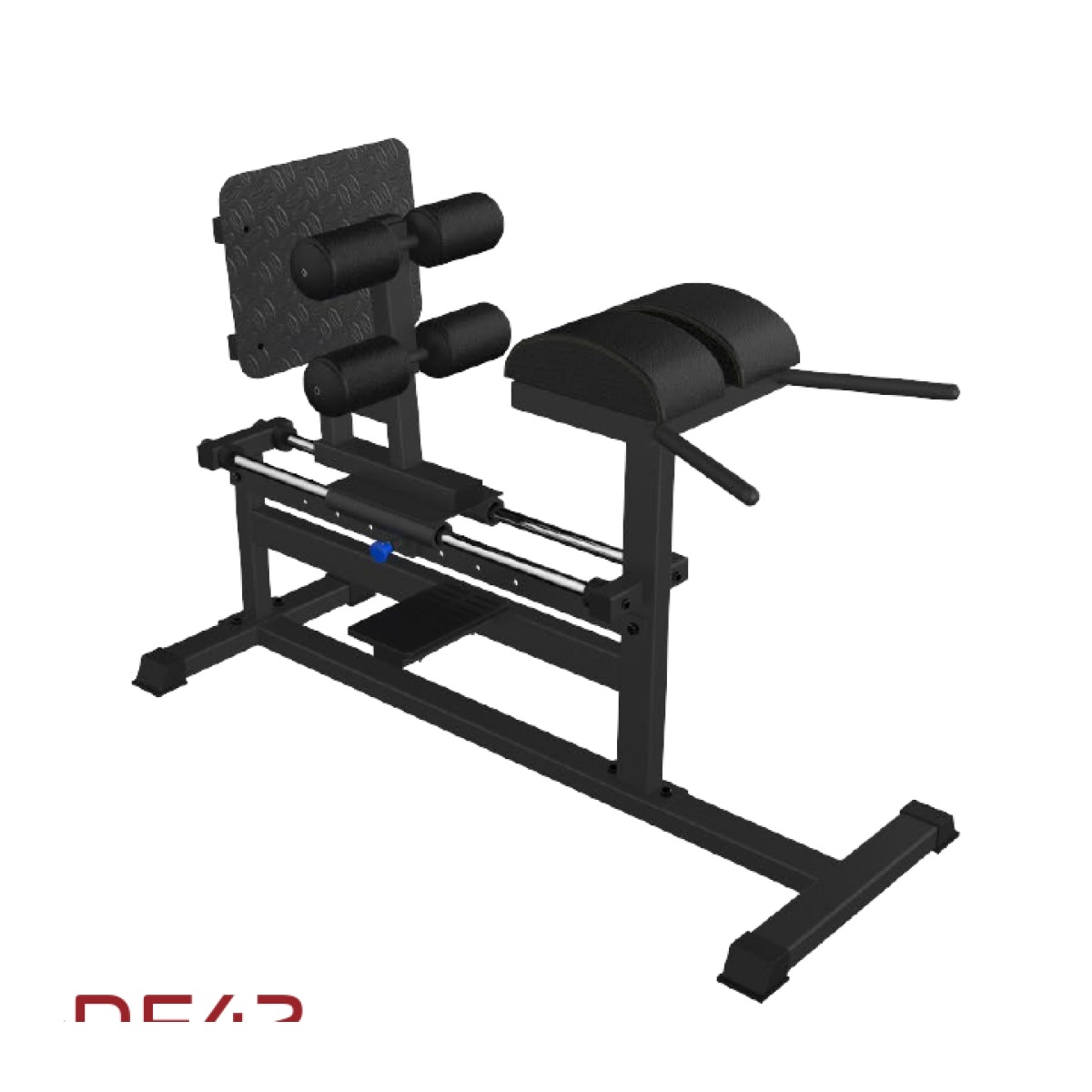
On a GHD, the user is restrained at the feet while the hips or thighs meet a split pad; adjustment geometry controls the relationship between support and movement. A 45-degree or Roman-chair bench supports the thighs on an inclined frame with a simpler ankle restraint. A selectorized back extension seats the user against a moving pad linked to a stack and a defined axis.
Walk through entry, adjustment, contact, start, controlled travel, return and exit on each offered model. Do not assume that a glute-ham developer, hyperextension bench and seated back extension create the same task or serve the same users. The best format is the one that performs the documented role with repeatable setup and manageable operating demand.
| Format | Best commercial role | Reference-unit checks | Planning consequence |
|---|---|---|---|
| GHD | Coached posterior-chain and trunk training with several exercise options | Footplate travel, ankle restraint, split-pad position, handles, frame stability and instruction | Longer setup and body travel require a generous live zone |
| 45-degree / Roman chair | Simple accessory work and fast turnover | Pad height and angle, ankle hold, step access, floor contact and loading policy | Compact operation, but external plates or bands need rules and storage |
| Selectorized back extension | Guided use for mixed-experience members | Seat and start settings, axis cue, lumbar contact, foot support, increments and exit | Stack and enclosure add service access while load changes are quick |
| Dual abdominal / back unit | Two functions where one-user capacity is sufficient | Changeover sequence, work-arm settings, labels and both movement paths | One frame saves area but both functions share a queue |
Prove fit across representative users
Test the smallest, middle and largest intended users rather than relying on one experienced lifter. On a GHD, verify footplate reach, ankle-pad spacing, hip contact and a stable mount. On an angled bench, check pad height, restraint contact and entry steps. On a seated unit, align the intended axis and confirm that the start position does not force an awkward pickup.
Record settings, contact points, controlled range and exit for every test profile. Reject a format if safe setup depends on improvised blocks, loose pads or staff holding the user in place. Adjustment labels must remain readable after cleaning, and pins or locks must engage completely without the user reaching into a moving area.
Calculate throughput and the complete live area
Time approach, adjustment, work, accessory loading, cleaning and exit during a realistic session. A versatile GHD can still become a bottleneck when every user needs several adjustments; a simpler bench can turn over faster; a selectorized station reduces plate handling but remains occupied during every set and rest interval. Use observed demand rather than a universal equipment ratio.
Draw the user envelope, mounting side, coach position, plate or band storage, circulation, cleaning access and technician zone around the frame. Check ceiling, wall, mirror and neighboring-machine conflicts through the full body path. Confirm packaged dimensions, door widths, lifts, turns and assembly order before the quotation becomes an order.
Specify resistance, restraint and wear points
For bodyweight stations, document permitted external loading, band anchors and the facility rule for holding plates. For a selectorized unit, request stack increments, starting resistance, effective delivered resistance method, travel and start positions. Listed mass does not explain how the user experiences resistance, and values from different mechanisms should not be compared without their transmission method.
Inspect pads, upholstery seams, footplate or foot supports, ankle rollers, adjustment tubes, handles, pivots, cables, pulleys, guide rods, fasteners and floor contacts. Cycle every setting under controlled use. Look for lateral movement, frame lift, rough travel, incomplete locking, pad rotation and pinch exposure. Ask how worn contact parts are identified by model revision.
Run a reference-unit trial before a fleet order
Use representative members, trainers, cleaning staff and a technician on the exact offered revision. Keep the trial focused on setup clarity, restraint, contact comfort, controlled movement, reset time and service access. It is not a contest for the heaviest repetition. Capture accepted settings and any user group that the station does not serve well.
Approve the unit only when the buyer can repeat the sequence without undocumented assistance. Save dated photographs, measurements, model identifiers, instructions and signed observations. If a supplier changes pads, adjustment holes, stack, work arm or base after approval, return the revision to the brief before shipment rather than treating it as equivalent.
Make quotations technically comparable
Require model and revision, format, intended exercises, user limits, adjustment ranges, restraints, pad geometry, handles, starts, resistance system, increments, dimensions, live-area allowance, finish, labels, anchoring, packaging, assembly, manuals, wear parts and acceptance steps. Price plates, bands, storage, installation and destination work separately so scope differences remain visible.
Ask for an exploded drawing, current manual, maintenance schedule, cleaning compatibility, part numbers and a route for revision-specific spares. Define who supplies tools, anchors, commissioning and staff handover. A lower machine price can create a higher project cost when unloading, floor protection, assembly or service access is excluded from the comparison.
Repeat the approved sequence at receiving
Match package marks, model, revision, quantity and condition to the order before assembly. Record freight damage and inspect frame, finish, pads, restraints, foot supports, adjustments, cables or pivots, labels, manuals and hardware. Assemble, level and anchor only as required by the current instructions while preserving the approved clearances.
Repeat the reference trial with the same user profiles and settings. Confirm stable entry, complete lock engagement, secure restraint, smooth controlled travel, predictable return and unobstructed exit. Record the asset identifier, result, owner and corrective closure. Release the station after staff understand inspection, cleaning and out-of-service rules.
FAQ
Is a GHD better than a back extension machine?
There is no universal winner. A GHD offers coached exercise variety, while a selectorized unit provides a more obvious guided task. Test the exact model against the facility brief.
Does a commercial gym need both a GHD and a Roman chair?
Only when measured demand, programming and peak capacity justify two roles. Many facilities should choose one format first and review utilization before adding another.
Which adjustments matter most on a GHD?
Footplate travel, ankle-pad relationship, hip-pad position, restraint security and stable access must cover the intended user range.
Can listed weight-stack mass compare machines?
No. Request starting and delivered resistance, transmission method, increments, travel and start positions for the exact revision.
What should receiving inspection include?
Verify identity, frame, pads, restraints, settings, motion, hardware, labels, documents, clearances and the complete approved user sequence.
Sources
- ISO 20957-1 general safety requirements — International Organization for Standardization
- ISO 20957-2 strength equipment requirements — International Organization for Standardization
- ISO 20957-4 strength bench requirements — International Organization for Standardization
- Precor Discovery GHD Bench — Precor
- Hammer Strength Select Back Extension — Life Fitness / Hammer Strength
- Rogue Abram GHD 2.0 — Rogue Fitness