
Plate-Loaded vs Magnetic Resistance Sleds for Commercial Gyms
Choose a plate-loaded skid sled when the program needs traditional friction work, compatible plates and a dedicated surface that has been tested with the exact runners. Choose a wheeled magnetic sled when rapid resistance changes, bidirectional use and lower dependence on sliding friction justify its larger mechanism and service needs. In both cases, approve the sled together with the lane, handles, straps, storage route, inspection plan and a repeatable receiving test.
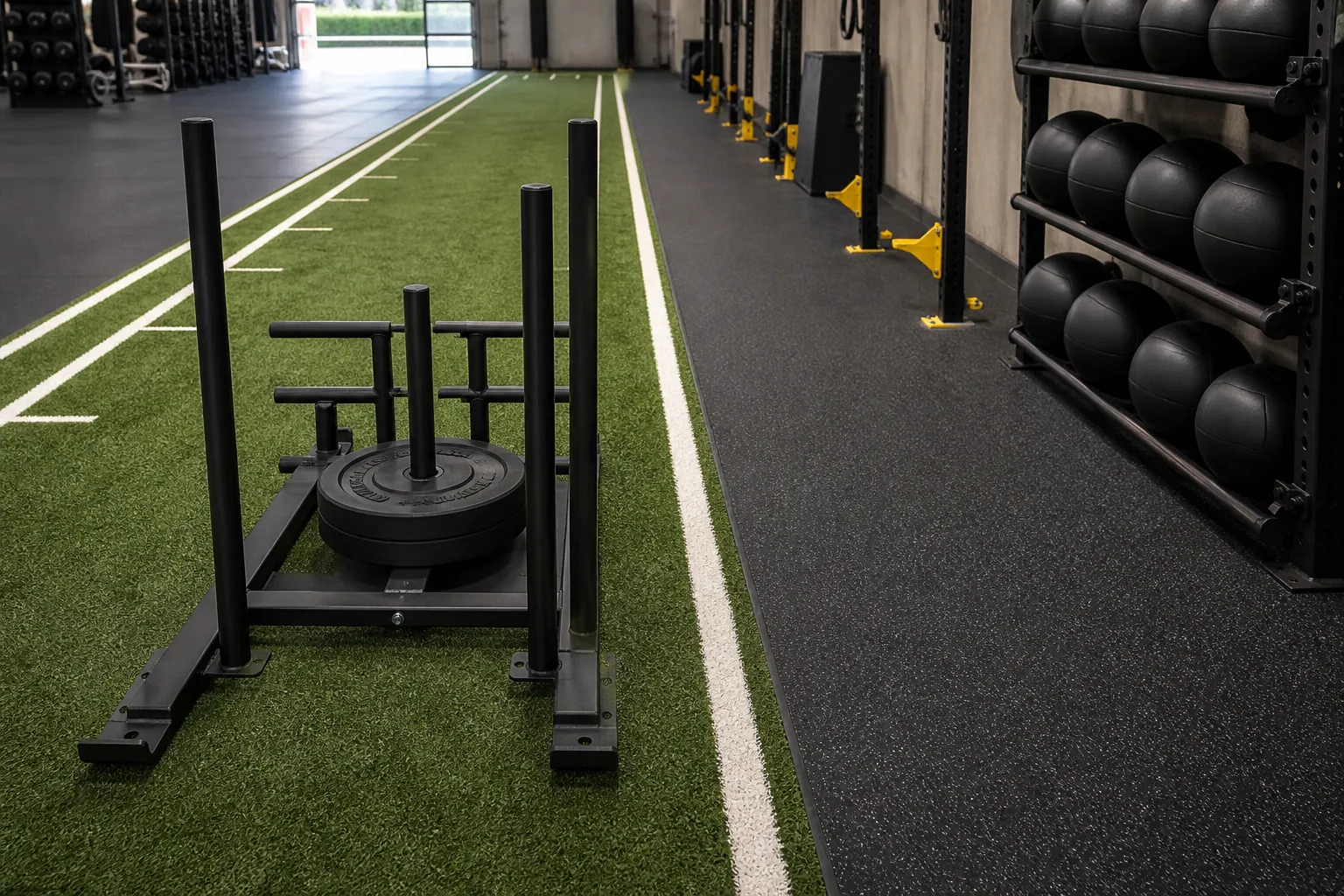
Define the training job before choosing resistance
Write down whether the station supports coached circuits, open-floor conditioning, sprint-resistance work, heavy pushes, backward drags or hybrid-race practice. Record active users per interval, work distance, recovery time, direction changes and supervision. Those facts determine capacity more reliably than the club's total membership or the maximum plate figure on a product page.
Separate the essential movement from optional variety. A compact drag sled, a push-pull prowler and a wheeled resistance unit do not create the same setup, body position or traffic pattern. If competition practice is part of the brief, document the event rules and surface separately; a general conditioning station does not need to imitate an event when that is not its job.
Compare resistance as a complete system
A plate-loaded skid sled develops resistance through the combined mass, runner geometry and friction against the lane. Turf fibre, pile direction, seams, dust, wear and moisture can change the feel. The same added plates therefore do not prove the same training demand on a different surface, and purchase approval should use the exact sled, runner and a representative installed lane section.
A wheeled sled uses a brake or magnetic mechanism to create resistance through the wheels. Adjustment can be quicker and some systems increase resistance with speed, but the buyer must confirm the exact model's control range, traction needs, bidirectional behavior, tires, bearings, braking components and service instructions. The label magnetic does not prove one universal response curve.
| Decision area | Plate-loaded skid sled | Wheeled magnetic sled |
|---|---|---|
| Resistance input | Plates plus runner-to-surface friction | Brake setting, speed and wheel traction |
| Reset task | Load or unload plates and reposition handles | Select setting and control direction change |
| Surface dependency | Direct and high | Lower sliding dependence but traction remains critical |
| Wear review | Runners, fasteners, straps and lane | Tires, bearings, brake, handles and controls |
| Best approval evidence | Exact sled on approved lane section | Exact sled through the planned route and settings |
Approve the lane, not only the catalog footprint
Draw the full travel length, start and braking zones, turning or return method, queue position, coach position and a clear route around the station. Add the sled at both ends, loose straps, plates waiting to be loaded and users walking back. A narrow strip that fits the frame can still fail when two participants, a coach and stored equipment occupy the same end zone.
Obtain the surface supplier's installation, seam, cleaning and use instructions, then test the runner or tire configuration on a representative installed section. Confirm transitions to rubber flooring, door thresholds, wall protection and nearby racks. Do not assume that optional plastic skis, metal runners or pneumatic tires suit every floor because each product's instructions define its approved use.
Calculate class capacity and changeover time
Model the busiest session as a timeline. Count push time, return, unloading, resistance adjustment, strap connection, handle change and the next user's safe entry. A sled that travels quickly can still be the bottleneck when every repetition ends with manual turning or when plates are shared with another station. Trial the rotation with the coaches who will run it.
For parallel lanes, measure separation under real use and define how users return without crossing an active path. For one lane, decide whether the sled is bidirectional or requires a turn and who controls that task. Keep a documented fallback for a damaged lane or an out-of-service sled so the class does not improvise in a circulation aisle.
Test handles, attachments and user control
List required push heights, low handles, pull points, rope, strap and harness interfaces. Verify that each attachment locks positively, does not enter the runner or wheel path and can be stored without creating a trip hazard. Test representative short, medium and tall users for hand position, visibility, start control, stopping and release at both ends of the lane.
Loading posts must match the plates specified for the facility, and collars or retention devices must follow the manufacturer's instructions. Check how staff add and remove plates without placing hands under the frame or blocking the next lane. On wheeled models, test traction at the strongest intended setting and confirm the procedure for loss of grip or an unintended direction change.
Plan storage, cleaning and service access
Map the storage route while the gym is open. Measure doors, corners, wall hooks or floor bays, and confirm whether handles fold or remove without loose parts being misplaced. The stored sled must not block fire routes, accessible circulation, electrical panels or cleaning equipment. Define where plates, ropes and harnesses return after every session.
Create an inspection list from the supplied manual: frame, welds, fasteners, loading posts, handles, attachment points, straps, runners, tires, bearings, brake controls and warning labels. Record the identifiers for replaceable runners, tires and hardware before ordering. Cleaning products and methods must be compatible with the sled finish, attachments and lane.
- Sled model and revision
- Approved lane and runner or tire
- Handles, straps and plate interface
- Working and storage envelopes
- Wear-part references and manuals
- Pilot and receiving test record
Normalize supplier quotations
Ask each supplier to separate the sled, handles, straps, harnesses, compatible plates, lane material, edge details, spare wear parts, assembly, freight packaging and documents. State what is excluded. A low frame price is not comparable with a complete station when the buyer must later source a lane, attachment hardware or replacement runners from another system.
Freeze model code, revision, finish, resistance architecture, controls, accessories, packaging marks and documentation in the order. Record the approved unit with photographs and test conditions, including surface and load method. Any substitution must be reviewed against the same program, lane, service and acceptance requirements before shipment.
Repeat the pilot at receiving
At delivery, match package and model identifiers, inspect distortion, finish, weld areas, fasteners, runners or tires, loading posts, handles, straps, guards and labels. Assemble by the supplied instructions and keep unresolved transport damage isolated. Confirm that every accessory and service document listed in the order is present.
Run the agreed test on the installed lane: unloaded or minimum permitted condition, representative working condition, each resistance setting where relevant, push and pull directions, stopping, turning, attachment changes and storage. Record the result and open a nonconformance for any difference rather than accepting a station solely because the sled moves.
FAQ
Is a magnetic sled better than a plate-loaded sled for a commercial gym?
Neither format is universally superior. A magnetic wheeled sled supports fast setting changes and less sliding dependence; a plate-loaded sled suits traditional friction work and existing plate systems. Program, lane, throughput and service evidence decide.
Can a push sled be used on rubber gym flooring?
Use only a combination approved by the sled and surface suppliers. Some skid sled guidance warns against high-friction rubber, while wheeled systems still require adequate traction and turning clearance. Test a representative installed section.
How long should a commercial sled lane be?
There is no universal length. Derive it from the programmed work distance, start and stopping zones, turn method, return traffic, room geometry and the rules of any event the facility intends to reproduce.
What should be included in a bulk sled quotation?
Include the exact sled and revision, resistance system, handles, pull attachments, plate interface, approved surface, storage method, wear parts, manuals, packaging, assembly scope and receiving protocol.
Why does a plate-loaded sled feel different on another turf?
Sliding resistance depends on the complete runner-and-surface contact. Fibre, seams, wear, contamination and direction can change friction, so added plate mass alone does not create a transferable result.
Sources
- TANK Push Sleds — Torque Fitness Commercial
- XF Sled / Prowler Heavy — Eleiko
- Eleiko XF Sled Light User Manual — Eleiko
- Rogue Dog Sled 1.2 — Rogue Fitness
- Maintenance of work equipment — UK Health and Safety Executive