
Smith Machine vs Power Rack vs Functional Trainer for Commercial Gyms
There is no universal winner. Choose a power rack first when coached free-barbell training is central; choose a Smith machine when the program needs a guided bar path and frequent solo setup; choose a functional trainer when adjustable cable work and exercise variety have priority. A combination station suits a compact, lower-throughput room only after confirming that the rack, guided bar and cables can be used in the intended sequence without interference.
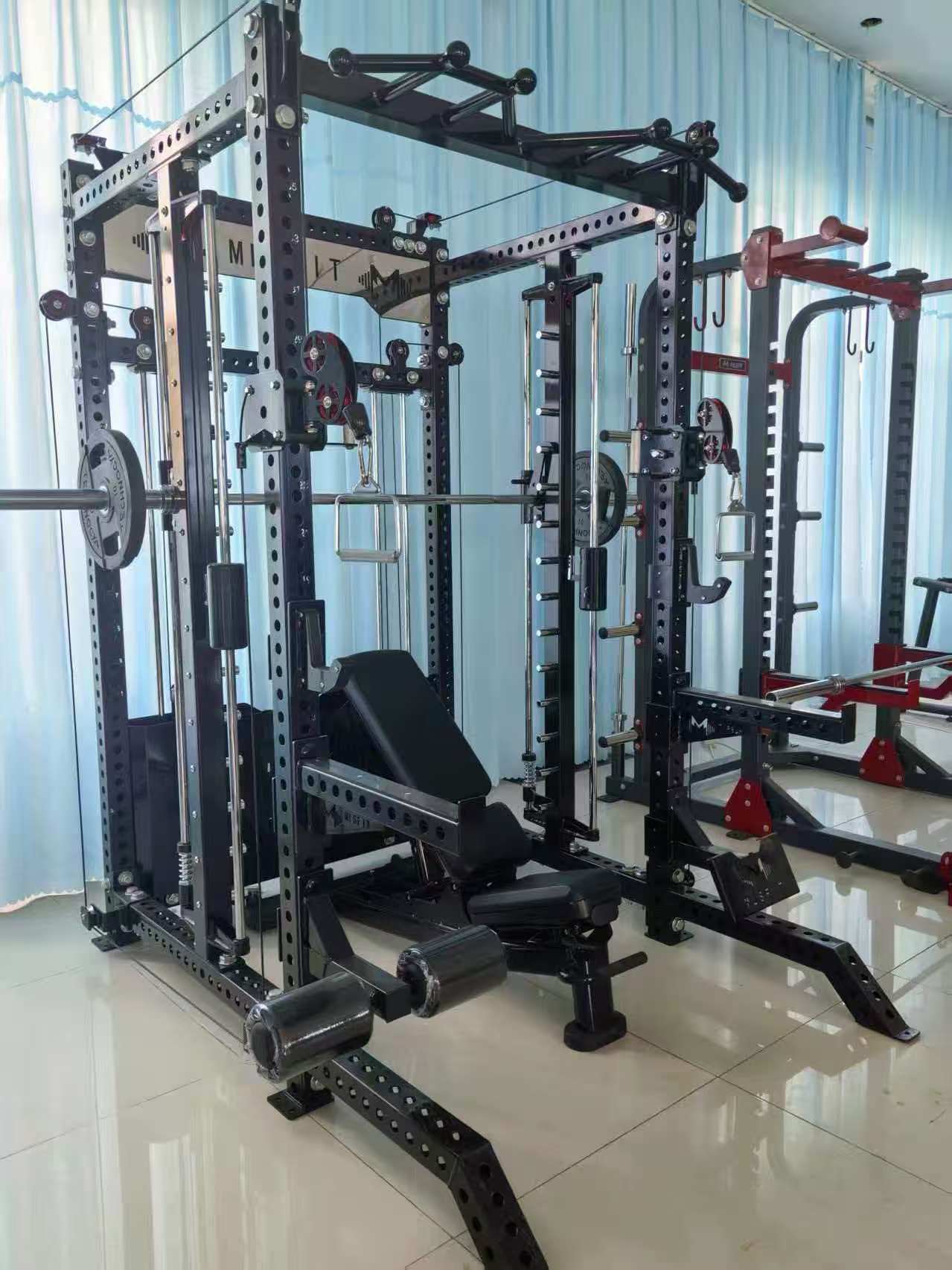
Start with the training program, not the product name
Write a one-page demand brief before comparing models. List the facility type, supervision level, member experience, coached sessions, main lifts, cable exercises, expected peak users and future expansion. A powerlifting club, a hotel room, a personal-training studio and a general membership gym do not need the same first station. The brief should also state whether users bring free-weight skills, whether staff can set safeties, and whether the site needs intuitive self-directed exercise during lightly staffed hours.
Separate essential tasks from attractive extras. Free-bar squats and presses require a rack, suitable bar, plates, safeties and a bench. Guided-bar work requires a Smith mechanism with usable start resistance, catch positions and travel. Adjustable cable work requires the correct resistance range, ratio, carriage heights, cable reach and handles. Count a function only when the quoted configuration includes everything needed to perform it safely and when another user is not occupying the same work zone.
Understand what each station actually provides
A power rack supports an independent Olympic bar on adjustable catches and safeties. It fits programs that value free bar paths, progressive barbell work, spotting access and attachments. A Smith machine constrains its bar to guide rails and lets the user rotate it into catches; its starting resistance, rail angle, catch spacing, stop adjustment and usable travel are model-specific. Neither description proves suitability until the complete model and intended exercises are reviewed.
A functional trainer uses one or two adjustable cable outlets. Pulley ratio changes the force at the handle and the available cable travel, so stack mass alone is not a comparison. Independent sides support bilateral or alternating movements, but accessories, carriage range and the space swept by cables determine real variety. Integrated machines place two or three systems on one frame. They save separate frames, yet the buyer must map where the bar, bench, spotter, cable user and stored attachments occupy the floor.
| Station | Best fit | Capacity advantage | Critical buyer checks |
|---|---|---|---|
| Power rack | Coached barbell, strength and athletic programs | One rack position with free-bar flexibility | Catches, safeties, depth, anchoring, bar space and platform |
| Smith machine | Guided-bar work and frequent solo setup | Fast setup for a defined guided-bar task | Starting resistance, path, catches, lower stops, travel and sleeves |
| Functional trainer | Adjustable cable exercise and personal training | Two independent sides can support flexible coaching | Ratio, effective resistance, increments, travel, carriage range and handles |
| Integrated station | Compact sites with controlled concurrency | Several systems within one frame envelope | Interference map, included components, setup changeover and service isolation |
Match the station to members and coaching
Choose the power rack when the offer includes coached strength, Olympic-bar fundamentals, powerlifting or athletic preparation. Confirm that staff will teach catch and safety placement and that the floor plan allows a spotter and plate changes. A rack is not automatically the best general-member station merely because it supports many exercises; utilization depends on the skills, programming and supervision the facility actually provides.
A Smith machine can serve guided squats, presses and accessory patterns where a controlled bar track fits the program. A functional trainer suits personal training, hotels, corporate rooms and general clubs that need adjustable pulling, pressing, rotation and rehabilitation-style exercise choices. Do not label either as inherently safe for every user. Instructions, range setup, exercise selection, stops, attachments and staff oversight remain part of the operating system.
Calculate peak capacity and the complete live area
Place the manufacturer footprint on the scaled plan, then add the declared workout area, bar overhang, plate-loading side space, bench approach, cable travel, pull-up headroom, spotter position and circulation. Official commercial pages distinguish machine dimensions from recommended live area, which is why catalogue footprint alone understates the room needed. Check doors, columns, mirrors, sprinklers and ceiling services before approving the station or its assembly route.
Model a busy fifteen-minute period. If one person benches inside a combination unit, can another use both cable towers? Can plates be loaded without crossing a cable path? Must a shared bench be moved between every task? A separate rack and functional trainer can support more concurrent users even when their combined frame area is larger. For a hotel or appointment studio with one user at a time, a well-designed combination can be the better use of space.
Compare the technical specification line by line
For a rack, request overall and live-area dimensions, anchoring instructions, bar-catch and safety types, adjustment spacing, usable internal depth, declared load limits, storage limits, compatible platforms and included attachments. For a Smith machine, add unloaded starting resistance, guide angle, bar travel, catch positions, adjustable lower stops, bearings or bushings, plate sleeve and storage layout. Treat figures from other brands only as examples of what can be declared, never as PowerBaseFit specifications.
For a functional trainer, record actual stack mass on each side, effective handle resistance, pulley ratio, increments, cable travel, highest and lowest carriage positions, independent or linked operation, pull-up requirements and the exact handle pack. For an integrated station, obtain one configuration drawing that identifies every mechanism and exclusion. Ask whether adding the rack, Smith or cable option changes anchoring, height, capacity, access or warranty scope.
Choose integrated or separate equipment deliberately
An integrated station fits a compact personal-training studio, hotel, apartment gym or dealer display when one frame must cover several programmed tasks and peak concurrency is low. It can also simplify visual coordination and keep attachments in one zone. Approval should follow a real setup trial: place the chosen bench, bar and plates; move both cable carriages; set safeties; test the lowest and highest intended positions; and check that storage does not obstruct a movement.
Separate stations are stronger when a busy club needs simultaneous users, different coaching groups or independent maintenance. A cable outage should not remove the only rack, and a barbell session should not block all adjustable-pulley work. The trade-off is more floor, anchoring, shipping pieces and duplicated structure. Compare total installed scope and usable station-hours, not only the number of functions printed beside a single model.
Plan installation, accessories and service access
Confirm subfloor conditions, approved anchoring method, protective flooring, ceiling height, assembly sequence and delivery access with the responsible site professionals. Keep emergency routes and accessible circulation clear. Establish where bars, plates, collars, handles and benches return after use. Storage horns filled on one side, loose cable handles or a bench parked across a walkway can undo an otherwise sound layout.
Request the inspection and lubrication schedule, cable and pulley checks, guide-rail care, fastener checks, wear-part list, part identifiers and service-clearance drawing. Staff should be able to isolate one function when a defect is found and record the exact model and serial identity. Confirm which cleaning products suit grips, upholstery, coatings and cable jackets. Serviceability should be reviewed before purchase, especially when one integrated frame concentrates several important functions.
- State the user groups, coached exercises and expected peak concurrency.
- Submit a scaled plan with machine, workout, loading and circulation zones.
- Request mechanism-specific figures instead of one general capacity claim.
- List every bar, bench, plate, safety, handle and storage component included.
- Define pre-shipment and installed acceptance checks for the exact configuration.
Turn the decision into a quotation and acceptance record
Send each supplier the same schedule: facility, destination, user groups, exercises, peak users, available live area, floor and ceiling information, required mechanisms, resistance system, bar and plate standard, bench, attachments, storage, color, branding, packing, documents, installation and service support. Require alternatives on separate lines. This prevents a compact quotation from silently omitting safeties, handles, benches or plates needed for the intended program.
Before shipment, match the finished unit to the approved model, drawing, finish, labels, attachments, fasteners and packing list. After installation, check stability and anchoring, catches and stops, unloaded bar movement, carriage locks, cable routing, effective resistance information, adjustment range, clearances and every included accessory. Record exceptions and corrections before handover. The best choice is the station that passes the buyer's actual program, capacity and acceptance criteria, not the longest feature list.
FAQ
Can an all-in-one station replace three separate machines?
It can cover several functions in a compact, lower-throughput room, but it does not automatically provide three simultaneous user positions. Test bench, bar, cable and storage interference against the intended session plan.
Which station should a new commercial gym buy first?
Base the first purchase on the dominant program. Coached free-barbell training points toward a rack; guided-bar demand toward a Smith machine; diverse adjustable cable work toward a functional trainer.
Is a Smith machine safer than a power rack?
Do not make a universal claim. Each relies on correct setup, instructions, stops or safeties, suitable exercises, inspection and user behavior. Compare the exact mechanisms and operating plan.
What should be included in the quotation request?
Include the room plan, users, exercises, peak capacity, live area, floor and ceiling data, mechanisms, resistance, accessories, storage, finishes, packing, installation documents and acceptance tests.
Sources
- ISO 20957-1:2024 — General safety requirements — International Organization for Standardization
- ISO 20957-2:2024 — Strength equipment requirements — International Organization for Standardization
- Life Fitness Axiom Series Smith Rack — Life Fitness
- Precor Discovery Power Rack — Precor
- Precor FTS Glide commercial brochure — Precor