
How to Choose Weight Plates for a Commercial Gym
Choose weight plates by training zone and operating rule, not by coating name or price per kilogram alone. Full-size bumper plates suit zones where approved lifts are lowered onto a suitable platform; coated grip plates suit controlled general-strength work and frequent machine loading; thin calibrated steel plates serve specific powerlifting or competition briefs. For every type, confirm the centre opening, outside diameter, thickness, mass tolerance, hub construction, permitted impact, marking system, bar and machine fit, storage, cleaning method and receiving test before ordering in volume.
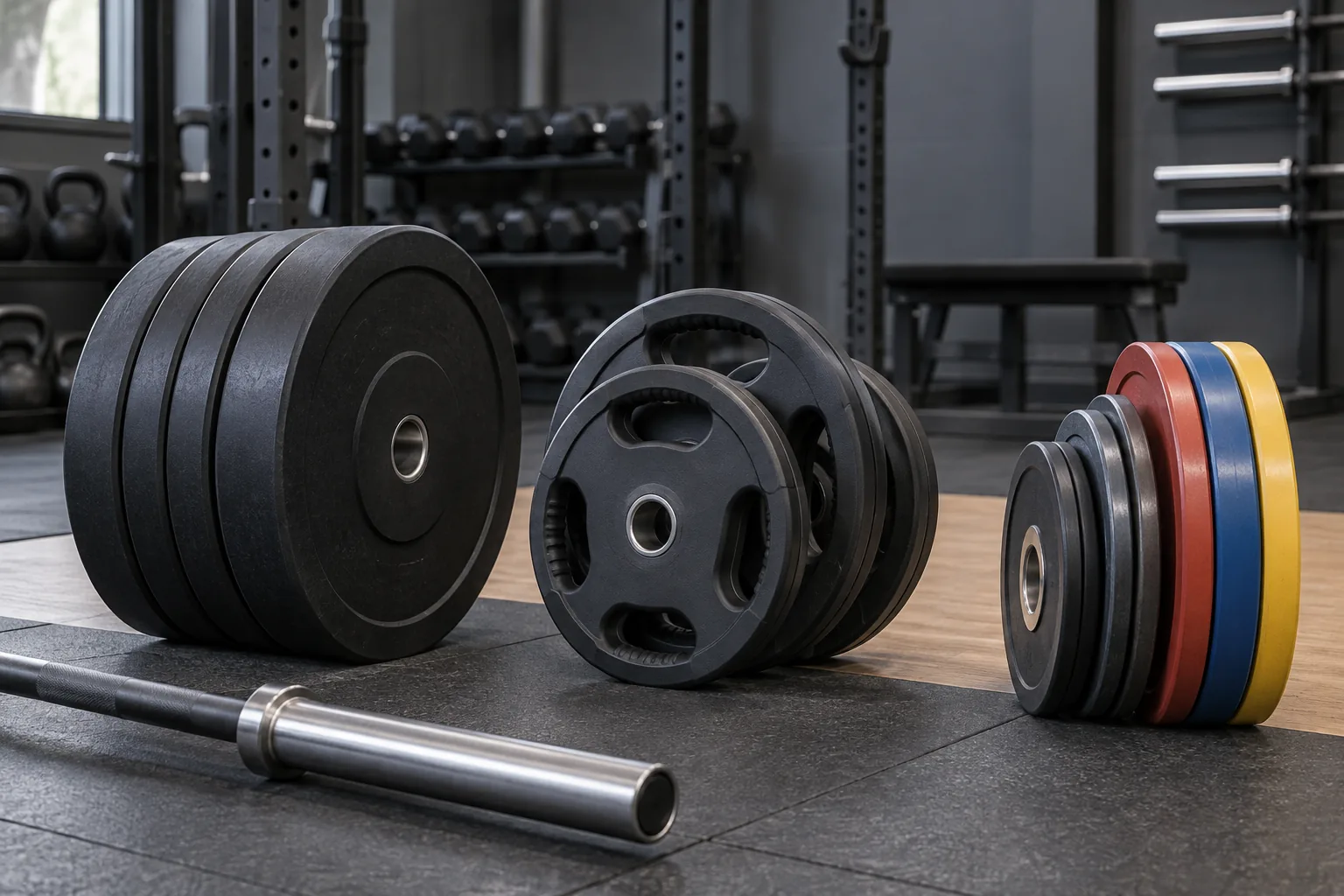
Assign a plate family to each training zone
Begin with the lifts, coaching model, member experience and impact rule in each zone. A supervised weightlifting platform, a general free-weight area, a powerlifting station and a row of plate-loaded machines do not need an identical plate mix. Record whether a loaded bar may contact the floor, how it must be lowered, which platform is used and who enforces the rule. Then name the plate family and denominations for that zone instead of ordering one mixed pool for the whole facility.
Full-size bumper plates can support approved floor-based lifting when the exact product, bar and platform are intended for that use. Coated grip plates make frequent loading, carrying and controlled rack work easier to organize. Thin calibrated steel plates conserve sleeve space and serve precise strength-sport briefs, but they do not replace bumpers in a drop zone. Many commercial projects need two or three controlled fleets with clear storage and color or label logic.
| Plate family | Best procurement fit | Key trade-off | Evidence to request |
|---|---|---|---|
| Full-size bumper | Weightlifting or functional zones with a written impact policy | More sleeve and storage width | Diameter, thickness, insert, rebound or hardness method, permitted drops |
| Coated grip plate | General strength, racks and plate-loaded machines | Not automatically approved for dropping | Core, coating, handles, centre insert, cleaners and impact limits |
| Calibrated steel | Powerlifting or exact competition brief | Noise and floor contact require control | Mass tolerance, diameter, thickness, calibration and current approval if required |
| Change or fractional | Small load progression | Easy to lose or mix | Mass steps, fit, marking and dedicated storage |
Freeze the interfaces before choosing material
Request the centre-opening diameter and tolerance, hub or insert material, outside diameter, thickness by denomination and any chamfer. Match them to the approved bar sleeve, collars, plate-loaded machine pegs and storage posts. Check the usable sleeve or peg length after collars, stops and frame clearance are included. A plate can be the correct nominal weight yet bind, wobble, damage a finish or consume too much usable length on the intended station.
For floor-supported lifts, verify which denominations share the declared full outside diameter. Mixing a full-size plate with a smaller plate shifts floor contact onto the larger disc; mixing different materials or diameters can change how the set responds when lowered. IWF and IPF dimensions apply to their governed competitions, not automatically to every commercial room. Cite the relevant rule edition only when that exact discipline is in the project brief.
Calculate quantity from simultaneous stations
Build a station-by-denomination matrix. For each rack, platform or machine, record the heaviest planned working load, the useful increments, expected simultaneous users and where plates may be shared without crossing an active lane. Add class turnover and accessibility needs. This reveals whether the real shortage is heavy pairs, small change plates or storage near a busy machine rather than total kilograms across the building.
Keep metric and imperial fleets separate unless the operator has a deliberate conversion and marking policy. Write quantities as pieces and pairs by denomination, not only as total mass or a vague set. A service reserve should have a stated purpose, storage position and release rule. It should not hide an incomplete station calculation or become an uncontrolled pile that staff cannot count.
Compare construction, finish and markings
For bumper plates, ask how the elastomer body joins the centre insert, how hardness or rebound is measured, which surfaces and temperatures are allowed and what evidence supports the stated use. For coated iron, identify the core, coating material, bonding, insert, handle geometry and exposed edges. For steel plates, inspect machining, edge finish, corrosion protection and calibration method. Material names alone do not establish durability or permitted impact.
Markings must remain legible under the site's lighting and cleaning regime. Freeze unit system, denomination, color reference, logo method and face layout in the approved artwork or reference unit. If private labeling is required, separate molded, printed or inlaid elements and state acceptable position and contrast. Do not describe a colored plate as federation approved without current evidence for the exact model.
Plan handling, storage, flooring and cleaning
Map the journey from storage post to bar or machine. Users should not carry heavy plates through another station's lifting path, and storage pegs must accept the quoted plate thickness and hub without trapping fingers against a frame. Check tree stability, wall anchoring where applicable, floor capacity and access for cleaning. Local qualified parties must confirm structural and installation requirements for the building.
Set the impact and cleaning policy from the ordered products' current instructions. Bumpers still need an appropriate platform and clear landing area; coated plates still need controlled handling; calibrated steel needs protected contact surfaces. Approved cleaners, drying, inspection and chalk removal vary by material. Separate any plate with a loose insert, split body, sharp edge, severe corrosion, unreadable mass or other written rejection condition.
Approve a production-representative reference set
Approve at least the critical denominations from the intended production construction, including a light full-size plate when that size is most vulnerable to flex and a heavy plate when sleeve capacity matters. Record mass, centre opening, outside diameter, thickness, flatness, insert seating, surface, odor, markings and packaging. Fit the set to the actual bars, machine pegs, collars and storage, then run only the use allowed by the supplier's written instructions.
Turn observations into measurable gates. Wrong denomination, out-of-tolerance mass or dimensions, loose hub, rocking plate, sharp flash, damaged coating, inconsistent color beyond the approved limit, unreadable marking or failed fit needs a defined remedy. Photographs support the record, but gauges, scales and a signed specification make the reference reproducible for production and receiving teams.
Normalize quotations and bulk-order documents
Send each supplier the same schedule: destination, facility and zone, plate family, kilograms or pounds, denominations, pieces per denomination, centre fit, diameter, thickness limits, core and coating, insert, impact rule, colors, private label, cleaning, storage interfaces, packaging and acceptance method. Request exact model codes, current drawings, instructions, test evidence, commercial-use warranty scope and declared exclusions.
Compare the landed system rather than price per kilogram alone. Include collars, bars, plate trees, machine compatibility, protective packaging, pallet and package mass, inspection, freight, duties, replacement units and artwork control. Freeze how substitutions and later production changes are approved. A lower quote is not equivalent if it omits thickness, tolerances, insert construction, package identification or per-denomination quantities.
Inspect packaging, dimensions and mass at receipt
Before unloading, reconcile pallet, package and denomination counts with the packing list. Confirm package mass and lifting method against site equipment, protect finished floors and record impact or water damage. Every plate or the agreed statistically valid lot plan should be checked for code, denomination, marking, surface, insert, edge and packaging identity before it is mixed into the operating fleet.
Use a calibrated scale and agreed method for mass; use suitable gauges for the centre opening, outside diameter and thickness. Check flatness on the defined surface, fit on the approved sleeve or peg, collar clearance and storage access. Perform a drop or rebound test only where the manufacturer permits it, the approved platform is ready and the method is written. Record accepted, quarantined and corrected quantities by denomination.
Create a repeatable reorder and maintenance baseline
Store the approved specification, artwork, color reference, measurements, photographs, batch identifiers and receiving results with the asset register. Later reorders should state whether new plates must match the original approved configuration or an updated revision. Compare centre fit, thickness, markings and color before combining batches, especially where one replacement pair must share a bar with older plates.
Give staff a simple inspection route: verify counts and storage, wipe with the approved product, check inserts, surfaces, edges and markings, then log isolated units. Trends such as repeated hub movement, coating separation or missing light plates can guide the next purchase. The goal is a controlled fleet that remains compatible and countable, not a succession of unrelated sets.
- Zone and permitted use
- Pieces by denomination
- Centre opening, diameter and thickness
- Core, coating and insert
- Marking, color and private label
- Reference-set approval
- Packaging and receiving method
- Reorder revision and maintenance record
FAQ
Should a commercial gym buy bumper or coated grip plates?
Buy bumpers for zones whose approved lifts and platform require controlled floor contact. Use coated grip plates for general racks and plate-loaded machines where handling and controlled lowering dominate. A mixed facility often needs both.
Are all rubber plates safe to drop?
No. Coated iron plates and bumper plates can both use rubber, yet their cores, inserts and intended use differ. Follow the exact model's written impact instructions and the facility's platform and operating policy.
How many weight plates does a gym need?
Calculate pieces by denomination for simultaneous racks, platforms and machines, planned loads, increments and class turnover. Total kilograms alone does not show whether every active station can be used.
When are calibrated plates worth specifying?
Specify them for a powerlifting, testing or competition brief that needs their tolerance and thin profile. General fitness floors do not gain automatic value from competition terminology.
What belongs in a receiving inspection?
Check counts, codes, mass, centre fit, outside diameter, thickness, flatness, insert, surface, markings, packaging, bar and machine compatibility, storage and only the permitted functional test.
Sources
- IWF equipment rules for discs — International Weightlifting Federation
- IPF technical rules — International Powerlifting Federation
- Eleiko bumper plate information — Eleiko
- Life Fitness barbells and plates catalogue — Life Fitness / Hammer Strength
- Hammer Strength rubber bumper specifications — Life Fitness / Hammer Strength
- Eleiko calibrated powerlifting plate sheet — Eleiko