
Introduction
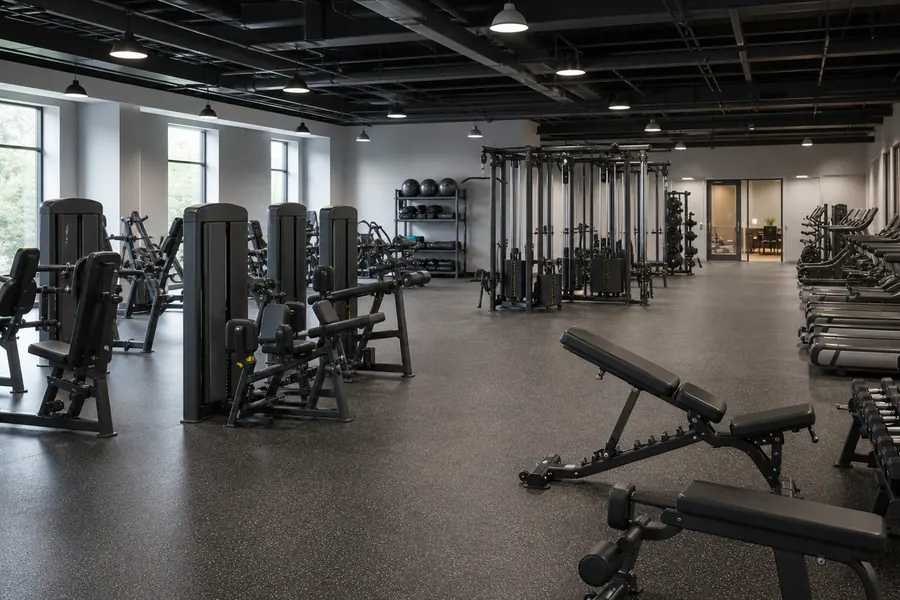
The best commercial fitness equipment for a new gym is a balanced, serviceable mix that fits the target members, training model, available floor area and operating budget. Start with versatile strength stations, essential free weights, scalable cardio and functional equipment, then add specialized machines only after the core training journey is complete.
Key takeaways
- Define the gym type: State the target members, price position, coaching model and training identity.
- Measure the real space: Use a scaled plan with columns, doors, ceiling limits, power and circulation constraints.
- Map training coverage: Cover the core movement patterns and cardio demand before adding specialist stations.
Planning context
A new gym does not need the longest possible equipment list. It needs enough capacity in the right movements, a layout that members understand, and machines the operating team can maintain. That means the buying decision starts with the business model and floor plan rather than with a catalog page or a low unit price.
From a manufacturing and project-planning perspective, the strongest opening packages are built in layers. A dependable core covers push, pull, lower body, free-weight, cardio and functional training. Optional pieces then sharpen the gym's positioning without consuming the budget or circulation space needed by the core. This guide explains how to build that mix and how to discuss it clearly with a supplier.
The Best Equipment Is the Mix That Supports Your Gym Model
Commercial gyms usually choose equipment based on who will use the facility, how those users prefer to train, and how the operator plans to earn and retain membership revenue. A neighborhood fitness club serving beginners needs intuitive selectorized machines, approachable cardio and a tidy free-weight area. A strength-focused club needs more racks, plate-loaded machines, benches and storage. A coached studio may create more value with functional trainers, open floor and fewer fixed-path stations.
The word best therefore describes fit, not prestige. A premium machine that duplicates an existing movement can be a weaker purchase than a simpler station that closes a real training gap. Before requesting models, define the membership profile, expected busy periods, supervised versus unsupervised use, flagship services, and the experience the gym promises. These inputs determine the correct equipment categories and the number of user positions required in each zone.
Build the Opening Package Around Six Core Training Needs
A practical first purchase normally covers six needs: guided strength, free-weight training, lower-body capacity, functional movement, cardiovascular training and recovery or mobility space. The exact machine count changes by concept, but omitting an entire need makes the floor feel incomplete. Guided strength helps new members train with less setup. Free weights serve experienced users and allow many exercises from a smaller number of stations. Functional equipment supports coaching and variation. Cardio remains important for warming up, conditioning and members who prefer familiar self-directed exercise.
Within guided strength, begin with recognizable movement patterns rather than many narrow isolation stations. A chest press, vertical pull, seated row, shoulder press, leg press, leg extension or curl combination, and an accessible core option create a usable circuit. Add a functional trainer because one cable station can support pressing, pulling, rotation, arms and rehabilitation-oriented variations. Then use member profile and floor area to decide which specialist glute, calf, arm or plate-loaded machines deserve opening-day space.
Balance Selectorized, Plate-Loaded and Free-Weight Equipment
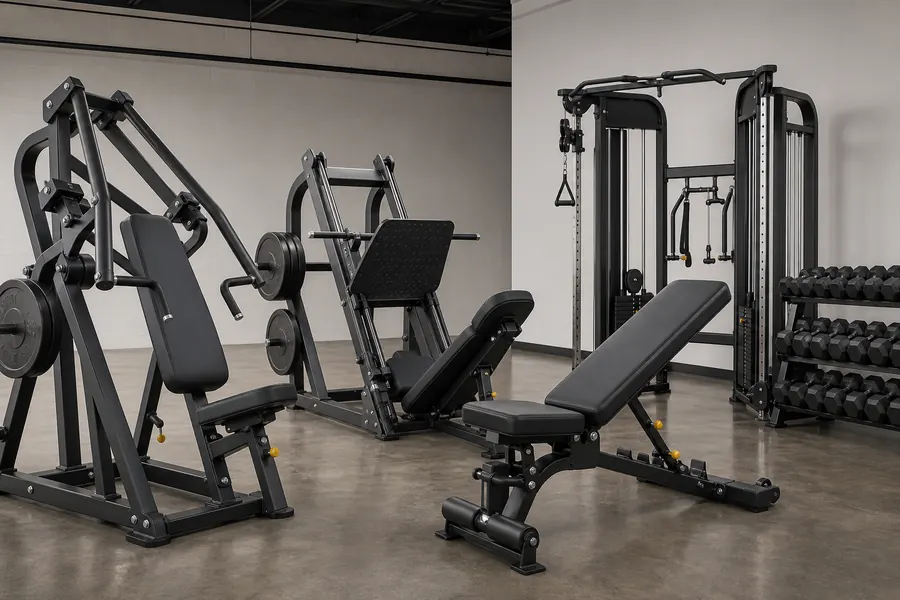
For a mixed commercial gym, no single strength format should carry the whole floor. Selectorized machines offer quick resistance changes and an easy learning path. Plate-loaded machines give strength-oriented users a familiar heavy-training experience and can create a stronger visual identity. Racks, benches, dumbbells and barbells provide the widest exercise variety, but they also require supervision policies, plate storage and enough clearance for safe loading and spotting.
A useful purchasing method is to map movement coverage before counting models. Mark every horizontal push, vertical push, horizontal pull, vertical pull, squat or press, knee extension, knee flexion, hip-dominant and core position. Duplicates are acceptable when demand justifies capacity, but accidental duplication often consumes money that should have funded a missing movement, an extra bench, better storage or resilient flooring. The goal is a coherent training journey rather than a showroom collection.
Choose Cardio by User Demand, Service Access and Electrical Planning
Cardio purchases should reflect expected usage instead of an assumption that every modality needs equal representation. Treadmills usually attract broad interest, but they also occupy meaningful floor area and introduce motors, belts, decks and electrical considerations. Bikes and ellipticals can broaden access for users who prefer lower-impact conditioning. Stair climbers or rowers may support a specific club identity, but specialist pieces should not displace the basic capacity your members will use every day.
Ask for installation requirements, recommended clearances, routine inspection points and the path for replacement parts before confirming the lineup. Plan outlets and cable routes early so power does not cross walkways. Leave service access around equipment rather than placing the rear or side housing tightly against walls. A lower acquisition price can lose its advantage if ordinary belt adjustment, cleaning or component replacement requires moving an entire row of machines.
Plan Training Zones Before Approving the Product List
Space planning converts a product list into an operating gym. Divide the room into cardio, selectorized strength, plate-loaded or free-weight, functional training, stretching and circulation zones. Then place equipment at its real working envelope, not only its catalog footprint. A leg press needs entry space and plate access. A rack needs bar movement, spotting and storage clearance. A cable station needs room for users to step away from the pulley. Benches move, so their parking and working positions both matter.
The layout should also match training sequence. Group related machines so users can understand the floor and staff can supervise it. Keep heavy plate traffic away from quiet stretching space. Put storage where the equipment is used, not wherever an empty wall remains. Protect primary walkways and emergency routes. If the plan only works when every movable bench, bar and attachment is perfectly placed, it is too dense for daily commercial operation.
Estimate Quantity from Concurrent Users, Not Floor Area Alone
There is no universal machine-per-square-meter formula. Two gyms of the same size can need different packages because their peak attendance, coaching model and member behavior differ. Estimate how many people will train at the busiest realistic period, then allocate simultaneous positions across the zones they are likely to use. A rack bay, treadmill, selectorized machine and cable handle are all user positions, but their turnover and supervision needs are different.
Prioritize extra capacity where queues would damage the experience. More benches and duplicate popular lower-body or pulling positions may be more valuable than rare specialist machines. Leave a portion of the floor and budget available for measured expansion after opening. Phased procurement is not a sign of an incomplete plan when the opening package already supports the full training journey; it is a way to use real utilization evidence before committing to the next specialist purchase.
Budget for Ownership, Installation and Opening Readiness
The equipment invoice is only one part of the opening cost. Buyers should model freight, import charges, inland transport, unloading, installation, flooring, mirrors, electrical work, assembly labor, spare parts and the time needed for commissioning. If the equipment is customized, confirm whether artwork, color samples or packaging changes affect cost and lead time. Keep a contingency for layout adjustments and the small accessories that make the floor usable on day one.
Compare total ownership demands rather than treating every lower price as a saving. Ask how cables, pulleys, upholstery, belts and electronic components are accessed and replaced. Confirm which routine tasks staff can perform and which require a technician. A machine family with shared wear parts and consistent adjustment hardware can simplify inventory and training. This operational consistency may be more valuable than a one-time discount across a collection of unrelated models.
Give Suppliers a Project Brief Before Asking for Models
A supplier can recommend a more defensible package when the inquiry includes a scaled floor plan, target member profile, gym positioning, preferred training zones, estimated budget level, destination, required opening date and any branding needs. Share constraints such as columns, low ceilings, lifts, narrow doors, limited electrical capacity or noise-sensitive neighbors. These details change which products can be delivered, installed and maintained successfully.
Ask the supplier to return a category-level rationale, not only a list of codes. The response should explain why each machine belongs in the mix, where duplicate capacity is intentional, what has been left for a second phase and which details require confirmation. When a proposal cannot be connected to member needs or the floor plan, it is still a catalog selection rather than a commercial gym solution.
Buyer decision framework
- Define the gym type: State the target members, price position, coaching model and training identity.
- Measure the real space: Use a scaled plan with columns, doors, ceiling limits, power and circulation constraints.
- Map training coverage: Cover the core movement patterns and cardio demand before adding specialist stations.
- Model peak capacity: Estimate concurrent users and strengthen the zones where queues would be most damaging.
- Compare ownership demands: Review service access, wear parts, warranty scope, installation and spare-parts planning.
- Approve a phased package: Open with a complete core and reserve expansion space for evidence-based additions.
Buyer checklist
- Target member profile and training concept are written down.
- Scaled floor plan includes columns, doors, windows, power and ceiling height.
- Every major movement pattern has suitable equipment coverage.
- Cardio quantity reflects expected demand and service clearance.
- Free-weight bays include plates, bars, benches and nearby storage.
- Working clearances are checked, not only catalog dimensions.
- Flooring, delivery, unloading, installation and commissioning are budgeted.
- Warranty process, spare parts and routine maintenance responsibilities are documented.
- Opening package and second-phase options are clearly separated.
Common buying mistakes
- Buying by unit price alone: This ignores service access, parts availability, installation and the cost of equipment that does not fit the member mix.
- Copying another gym's list: A list built for a bodybuilding club, hotel or studio may be wrong for a general membership facility.
- Using catalog footprint as working space: Users, plates, benches, cables and service access extend beyond the machine frame.
- Overbuying specialist machines: Opening-day variety can look impressive while leaving too little capacity in racks, benches, pulls, presses or cardio.
- Treating flooring and storage as extras: Poor storage and unsuitable surfaces quickly damage circulation, housekeeping and the member experience.
- Leaving maintenance until after delivery: The operator should understand inspection tasks, wear parts and support contacts before equipment enters service.
Manufacturer perspective
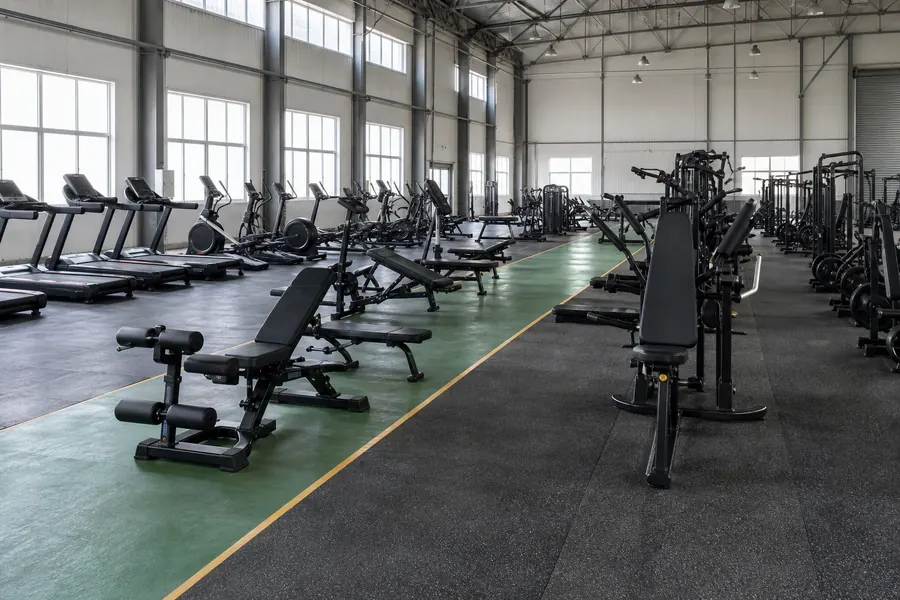
From a manufacturer's perspective, the useful project conversation begins when the buyer explains the people, space and operating model behind the request. That information allows the equipment mix to be reviewed for movement coverage, production compatibility, finish consistency, packaging and installation sequence instead of being priced as unrelated units.
During production planning, consistency matters. Related machine families can share finish standards, upholstery choices, hardware logic and common service parts. Before shipment, the order should be checked against the approved list, protected according to component shape and organized so the receiving team can identify frames, hardware, accessories and assembly priorities. These process controls do not replace buyer due diligence, but they make the project easier to verify.
Equipment Category Comparison for a New Gym
| Category | Primary role | Best users | Space implication | Opening priority |
|---|---|---|---|---|
| Selectorized strength | Guided full-body circuit | Beginners and mixed-level members | Medium; one movement per station | High for general fitness clubs |
| Plate-loaded strength | Heavy and visible strength training | Experienced and strength-focused members | Medium to high plus plate access | High for strength-led concepts |
| Free weights and racks | Flexible compound and accessory work | Intermediate, advanced and coached users | Needs lifting bays and storage | High in most commercial gyms |
| Functional training | Multi-directional cable and open-floor work | All levels with suitable guidance | Efficient when attachments are organized | High because one station covers many uses |
| Cardio | Warm-up and conditioning | Broad member base | High footprint per user position | Scale to demand rather than buying one of everything |
| Gym flooring and storage | Safety, zoning and housekeeping | Every user and staff member | Uses no training position but enables the floor | Essential infrastructure |
Useful next pages
Buyer FAQ
What equipment should a new commercial gym buy first?
Start with core guided strength movements, racks and benches, dumbbells and plates, a versatile functional trainer, essential cardio, suitable flooring and storage. Specialist machines should follow the gym's positioning and available capacity.
Should a new gym choose selectorized or plate-loaded machines?
Most mixed-member gyms benefit from both. Selectorized machines are accessible and quick to adjust, while plate-loaded machines support heavier strength training and a stronger strength identity. The ratio should follow the target user profile.
How many cardio machines does a new gym need?
Base the quantity on expected concurrent users, member preferences and peak-period demand. Begin with familiar modalities and allow electrical, ventilation, access and maintenance clearance for every position.
Is a functional trainer worth including in the first order?
Usually yes when it is placed and equipped correctly. One adjustable cable station can cover many upper-body, lower-body, rotational and accessory movements, which gives a new facility useful flexibility.
Can a gym open with phased equipment purchasing?
Yes. A phased plan works when phase one already delivers a complete member journey and the layout reserves safe space, power and budget logic for later additions based on actual utilization.
What should I send a manufacturer for an equipment recommendation?
Send a scaled floor plan, target member profile, gym concept, desired training zones, budget level, destination, opening schedule, access restrictions and any OEM requirements.
Conclusion
The best opening package is not the one with the most machines. It is the one that gives the intended members a complete, understandable training experience while remaining serviceable for the operator. Define the business model, build the core movement coverage, protect circulation and compare ownership demands before selecting specialist pieces. For a project-specific recommendation, prepare your floor plan, target member profile, preferred zones and budget range. A manufacturer can then turn those inputs into an equipment category plan, identify questions that still need confirmation and prepare a quotation scope for review.
Need this topic turned into a real equipment plan?
Send your market, gym size, product categories or OEM needs. Kloe can help clarify the next step.