
Functional Trainer vs Cable Crossover for Commercial Gyms
Choose a compact dual adjustable pulley functional trainer when the project needs many cable angles in controlled frame width and can schedule one central working zone. Choose a wide adjustable cable crossover when the program needs generous separation between outlets, broad bilateral paths or two clearly separated work sides and the room can support the full live area. Product names overlap, so compare the exact offered configuration for outlet spacing, height and rotation, cable travel, effective handle resistance, two-user interference, bench position, attachment set, service access, delivery and acceptance evidence before ordering.
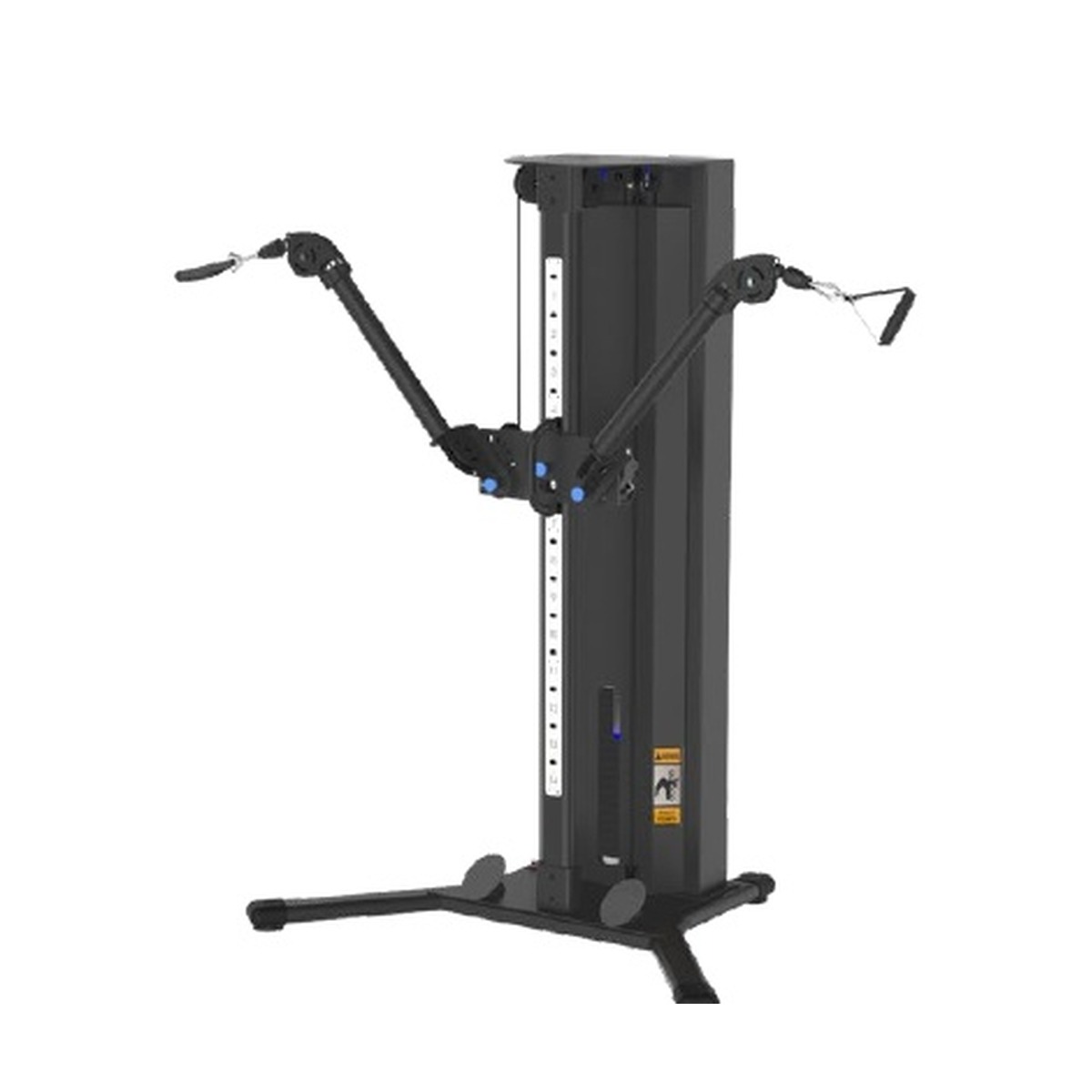
Identify the architecture before comparing names
A functional trainer is commonly a compact two-outlet cable station, but the outlets can be vertical carriages, articulated arms or another adjustable arrangement. A cable crossover is commonly understood as two opposing outlets with more open distance between them, yet current products can also use adjustable carriages and compact frames. Treat those labels as search terms rather than technical specifications. Ask every bidder for a front view, plan view and outlet-motion diagram of the exact model.
Record whether each side has an independent stack, whether the outlet moves vertically or also changes angle, the minimum and maximum separation between handles, and which central structures occupy the space between users. A pull-up bar, storage shelf, stabilization pad or integrated rack changes the operating zone. The procurement record should describe the delivered architecture instead of forcing an ambiguous marketing name into the order.
Build the exercise and user schedule first
List the movements that create commercial value: single-side rows and presses, high-to-low and low-to-high pulls, broad fly patterns, rotation, assisted balance work, trainer-led sessions, bench exercises and attachment-based arm work. For every movement, note the outlet height, required cable distance, expected resistance range, bench position and whether a second person needs the opposite side at the same time. This turns an exercise list into a station specification.
Then model the busiest fifteen minutes. A personal training studio can value rapid changes around one client, while a large club can need two independent users with separate stacks and attachment storage. Do not count two handles as two usable stations until the model has been tested with the intended movements. Crossing cables, a shared bench, one central standing area or access to the selector pins can reduce practical concurrency.
Normalize the technical comparison
Request the same data for both formats. Stack mass is only an input; the handle receives the result of the pulley system. Obtain pulley ratio, effective resistance at each outlet, starting resistance, increments, usable travel and the method used to state those figures. If a bidder supplies only a family brochure, require the code and revision for the offered configuration before comparing it with another model.
The table below is a decision record, not a claim that every product follows one pattern. Current official specifications show that commercial dual adjustable pulleys and adjustable crossovers can use different ratios, travel and frame geometry. Those examples demonstrate why buyers should compare model evidence rather than transfer one brand’s values to PowerBaseFit or to another supplier.
| Decision row | Compact dual adjustable pulley | Wide adjustable crossover | Evidence to request |
|---|---|---|---|
| Architecture | Two nearby adjustable outlets on one compact frame or arm system | Two separated outlets joined or installed as one wider system | Plan, front and side drawings for the offered code |
| Movement geometry | Broad angle choice where carriage or arms cover the required positions | Greater outlet separation where the frame and room preserve an open span | Outlet range, rotation and representative exercise trial |
| Resistance | Depends on each stack, ratio, increment, travel and friction | Depends on the same variables; width alone proves nothing | Effective handle resistance and test method |
| Concurrent use | Can support one or two users only after interference testing | Can create two work sides when paths and access remain separate | Peak-period simulation with planned attachments |
| Live area | Frame plus step-back distance, bench, cable sweep and service access | Frame width plus both work sides, central span and circulation | Scaled layout with operating envelopes |
| Operations | Frequent carriage or arm adjustment can suit guided sessions | Separated sides can reduce interference but increase inspection area | Instructions, wear parts, storage and service plan |
Draw the complete live area and delivery route
Place the machine on a scaled plan, then add the user, cable sweep, step-back distance, bench in every planned orientation, attachment change zone, selector access, storage and technician access. Repeat the drawing for two simultaneous users. A compact frame can demand a deep working zone, while a wide crossover can use a shallow frame but consume wall width and cross circulation. Compare the complete operating envelope, not square metres calculated from product dimensions alone.
Delivery needs a separate check. Obtain packaged dimensions, package mass, largest handled component, split points, lifting instructions, assembly sequence and anchoring instructions when applicable. Check dock, door, lift, corridor, turn and final ceiling height. State who unloads, moves, assembles, anchors, levels, tests and removes packaging. A machine that fits the room can still fail the project if its largest component cannot reach it.
Test resistance, travel and adjustment as one system
Trial the lowest useful load, the first increment and the heaviest planned exercise with representative users. Move through low, mid and high outlet positions and check that the cable remains controlled without contact, excessive slack or an abrupt change in feel. Measure whether the available travel supports the intended step-back and long-range movements. Compare left and right sides rather than accepting one smooth demonstration.
Adjustment quality affects throughput. The carriage or arm should lock positively, show understandable positions and remain reachable for the intended user range. Check selector-pin access when another person occupies the opposite side. Confirm which handles, straps, bars, ropes and storage points are included, and test every connection interface. An impressive accessory list has little value when changeover blocks the other user or leaves loose items in circulation.
Plan inspection, cleaning and parts identity
Build routine inspection from the model instructions and the facility’s usage. The record should cover cable surfaces and ends, pulleys, guards, carriage locks, selector pins, guide rods, fasteners, frame contact points, handles and storage. Define the defect that removes a station from service and who can release it again. Inspect both sides independently because unequal wear can hide behind a machine that still moves.
Ask the supplier for model and serial identity, cable and pulley part references, compatible attachment limits, cleaning guidance, service clearances and a route for replacement parts. Confirm whether a cable, carriage or guard can be replaced without moving adjacent equipment. Compare warranty inclusions with labour, travel, freight and diagnostic responsibility. Uptime depends on a documented support chain, not the number of exercises in a brochure.
Write a comparable quotation and approve a reference unit
Send one brief to every bidder. It should include facility type, user profile, operating hours, busiest-period schedule, movement list, available room, delivery restrictions, attachment requirements, finish and branding scope, documents, installation responsibility and acceptance method. Require separate lines for included and optional attachments, storage, freight, assembly, anchoring, spares and training. This keeps a lower total from hiding a narrower scope.
Before a larger order, approve one production-representative unit or a fully controlled configuration. Record identity, drawings, outlet movement, effective resistance evidence, cable travel, included accessories, finish, labels, adjustment feel, two-user trial and service access. Photograph acceptance points without treating the images as dimensional proof. The approved record becomes the reference for production, pre-shipment inspection and receiving.
- Exact model, revision and architecture drawing
- Outlet height, angle, rotation and separation range
- Stack mass, pulley ratio, handle resistance and increments
- Usable cable travel and representative movement schedule
- One-user and two-user operating envelopes
- Bench positions, attachments and dedicated storage
- Packaged data, largest component and delivery responsibility
- Inspection tasks, wear parts and service clearances
- Finish, labels, documents and destination requirements
- Reference-unit approval and recorded receiving tests
Receive and commission against the approved record
At arrival, match model, revision, quantity and packages to the order before assembly. Preserve evidence of damage, count loose accessories and verify labels and documents. After installation, check stability and anchors where instructed, guards, cable routing, carriage locks, selector operation, full travel, handle resistance behaviour, attachment connections and abnormal noise. Repeat the planned bench and two-user trials in the final location.
The correct choice is the configuration that delivers the required movement geometry and peak-hour capacity inside a safe, serviceable zone. Send PowerBaseFit the country, floor plan, exercise schedule, user profile, preferred station count, attachment list and purchasing time so the quotation can distinguish compact and wide cable options with model-specific evidence.
Buyer questions
Are a functional trainer and a cable crossover the same machine?
The names overlap. Many functional trainers and adjustable crossovers both have two movable cable outlets. Compare the exact frame, outlet spacing, adjustment range, cable travel, resistance system and operating zone instead of relying on the label.
Which format uses less space in a commercial gym?
A compact dual adjustable pulley usually uses less frame width, but it still needs step-back distance, cable sweep, bench space and service access. A wide crossover needs more span and can create two work sides. Compare scaled live areas for the intended sessions.
Can two people use one functional trainer at the same time?
Only when the offered model has independent sides and the planned exercises do not cross cables, block selector pins, share one bench or place users in the same standing zone. Prove concurrency with a representative trial.
Is a heavier weight stack always better for cable training?
No. Stack mass does not state handle resistance by itself. Compare pulley ratio, starting resistance, increment, usable travel, friction and the heaviest intended exercise using model-specific evidence.
What attachments should be included in a commercial cable station order?
Specify attachments from the movement schedule and confirm connection compatibility, quantity, material, cleaning, storage and replacement identity. Common handles or ropes should be duplicated when simultaneous users need them.
What must be checked when the machine is installed?
Check identity, stability, instructed anchoring, guards, cable routing, outlet locks, selector pins, full travel, resistance behaviour, accessories, labels, noise, bench placement, two-user clearance and the complete handover file.