
How to Choose Free-Weight Storage Racks for a Commercial Gym
Choose storage racks from the exact dumbbell pairs, plate quantities and bar types that your facility will own, then verify each contact surface, rack capacity, loaded stability and user access on a scaled floor plan. A rack with enough nominal slots can still fail the project if wide dumbbells do not seat, bumper plates fill horns early, or users must carry weights across an active lifting area.
Start with a weight inventory, not a rack photograph
List every dumbbell pair by head shape and width, each plate denomination by diameter and thickness, and each bar by overall length and sleeve style. Include items already owned as well as the new purchase; a rack must work with the combined fleet. Record where each item is used, who returns it and whether a later expansion will require another shelf or horn.
Separate daily-use weights from reserve stock. A busy free-weight zone benefits from nearby return positions, whereas replacement stock can live outside the exercise floor. Make a count by location and peak class rather than assuming that one central rack will serve every bench or rack bay. Life Fitness and Eleiko both present dumbbell, plate and bar storage as distinct product families.
Match the storage form to the object
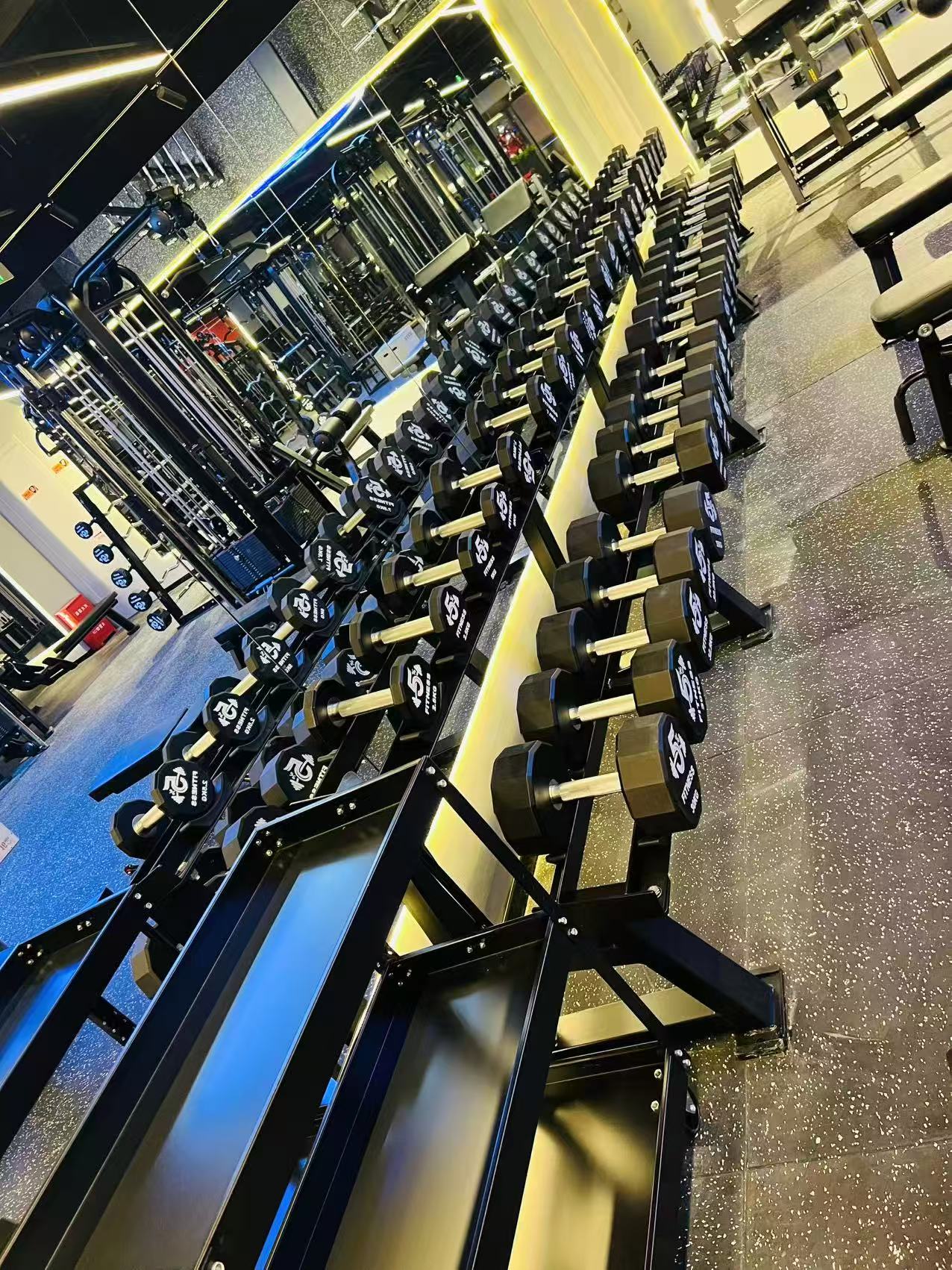
A two-tier or three-tier dumbbell rack is evaluated by the actual pair sequence, cradle contact and hand space; a plate tree is evaluated by horn diameter, usable length and plate order. Vertical bar storage saves floor area but needs safe insertion and overhead clearance. Horizontal bar storage needs enough length and separation to prevent collisions with neighboring equipment.
Mixed accessory shelves can organize kettlebells and smaller tools, but they do not automatically accept dense plate loads or long bars. Compare the manufacturers' permitted uses and declared limits for each offered rack. Eleiko's modular dumbbell storage illustrates how shelf and cradle designs may be optimized for particular dumbbell lines, so a buyer should test another brand's heads before treating them as interchangeable.
| Stored item | Rack form to compare | Critical fit check | Layout check |
|---|---|---|---|
| Dumbbell pairs | Tiered shelf or cradles | Head width and hand clearance | Return area before benches |
| Weight plates | Tree or integrated horns | Bore, thickness and horn length | Near loading stations |
| Barbells | Vertical or horizontal bar holder | Sleeve fit and retrieval path | Ceiling and swing clearance |
| Small accessories | Open shelf or dedicated hooks | Shape and retained position | No intrusion into aisles |
Measure fit and usable capacity
Ask for shelf length, shelf depth, cradle spacing, horn diameter and usable horn length on the exact rack model. Test the largest and smallest dumbbells, including coated heads whose shape differs from a round metal head. Place each pair in its intended position and confirm that fingers can grasp the handle without scraping the shelf or the next pair.
For plates, count physical thickness as well as total mass. Large bumper plates can exhaust horn length before a quoted load limit is reached; thin steel plates present a different handling pattern. Confirm that collars, handles and nearby frames do not obstruct removal. Use a full-size mock arrangement or an approved reference unit, and document the order of items on each horn or shelf.
Verify loading, stability and floor interface
Request the manufacturer's rated load, assembly drawing, leveling instructions and anchoring requirement for the selected model. Compare the total weight of the intended contents with the declared limits for the whole rack and any individual shelf or horn. Do not substitute a competing product's rating for PowerBaseFit's offer; obtain the figure tied to its exact item code.
Assess the rack in the loaded state: uneven plate distribution, one-sided retrieval and repeated returns can change stability. Confirm the floor is suitable, level and protected for the expected contact points. Follow the supplied installation method and local site requirements for any anchoring. A catalog footprint does not describe a loaded rack's reach envelope or the space needed to service its rear side.
Place racks along real user paths
Draw the rack on a scaled plan with benches, lifting platforms, machine plate horns, doors and cleaning routes. Add the user's standing position while lifting the heaviest planned item and the swing or carry path to the nearest station. Leave circulation and required access routes clear. UK HSE guidance for workplaces illustrates the value of orderly passageways; local rules and the project's actual use still govern.
Do not hide popular weights behind benches or make users pass through another lifter's bar path. A long dumbbell rack close to bench rows can shorten return trips, while plate storage near each loading zone may reduce cross-room carrying. Test the plan at peak occupancy, including two people returning equipment at once, rather than approving a layout from the empty-room image alone.
Check contact surfaces, cleaning and service
Inspect cradles, liners, shelf edges, plate horns, end stops, welds, fasteners and finish. Contact protection can reduce visible wear, but it must suit the actual dumbbell or plate shape and remain replaceable if the supplied design uses replaceable parts. Require cleaning instructions for the coating and liners used in the quoted model.
Plan a routine check for loose fasteners, damaged liners, bent horns, rocking feet and blocked labels. Remove a rack from service if its stability or retaining surfaces are in doubt, and isolate its contents safely. Record the rack code, location and issue so maintenance does not mistake a damaged return point for a missing dumbbell problem.
Compare quotations on one schedule
Send each supplier the same inventory and floor plan, then request item code, rack type, dimensions, load declarations, shelf or horn configuration, finish, liners, labels, installation method, packing, spare parts and documents. Identify whether bars, plates and dumbbells are in the same order or sourced separately; compatibility responsibility must be explicit.
Compare the delivered arrangement, not price per frame. Include freight mass, packaging, unloading, assembly, anchors where specified, replacement liners and later expansion pieces. Ask bidders to show any substitution on a separate line. A nominally cheaper rack is not equivalent if it requires more units, blocks a doorway or cannot hold the approved dumbbell range.
Approve a reference arrangement and receive the order
Before committing to a multi-site or large-floor order, build one rack with the intended heaviest, widest and smallest items. Check labeled positions, retrieval, return, stability and cleaning access with representative users. Photograph the approved arrangement and retain the exact item code and revision with the purchase order.
At delivery, reconcile cartons, parts, fasteners and labels against the schedule. Inspect coating, joints, feet and contact liners before loading; assemble to the supplied instructions and repeat the agreed fit and stability checks. Quarantine damaged or mismatched components. The handover record should say which racks and weight sets are accepted and ready for use.
Turn storage into an operating system
Give each weight a visible return position and keep the storage map with the equipment register. Review missing positions and crowding after opening; change the layout only after observing how people actually collect and return equipment. A tidy rack is valuable when it also reduces carrying and makes defects visible to staff.
For a PowerBaseFit quote, send the facility country, scaled room plan, exact dumbbell, plate and bar list, preferred rack locations, quantities and procurement timetable. The team can discuss the existing storage products and confirm model-specific dimensions, load declarations and installation information for the requested configuration.
FAQ
How many storage racks should a new gym buy?
Count the actual pairs, plates and bars for each training zone, then test the loaded configuration and the return path. The number of rack units follows the fit and layout, not the room area alone.
Can any dumbbell fit a rack labeled for ten pairs?
No. Pair count does not establish head width, cradle shape or hand clearance. Trial the exact smallest and largest heads and document the approved positions.
Should plates sit beside every strength machine?
Place frequently changed plates close to their loading station when the plan permits, while keeping user and circulation space clear. Match horn capacity and plate thickness to that station's inventory.
What proves a storage rack is stable enough?
Request the exact model's declared load, assembly and installation instructions, then test the intended loaded distribution on the actual floor. Do not infer performance from an image or another model.
What belongs in the purchase order?
Record rack codes, quantities, dimensions, rated loads, contact liners, horn or shelf configuration, finish, labeling, packing, installation documents and the agreed receiving test.
Sources
- Eleiko storage equipment range — Eleiko
- Eleiko dumbbell rack fit and modular design — Eleiko
- Life Fitness storage rack range — Life Fitness
- HSE workplace passageway requirements — UK Health and Safety Executive
- HSE manual material handling and rack access — UK Health and Safety Executive